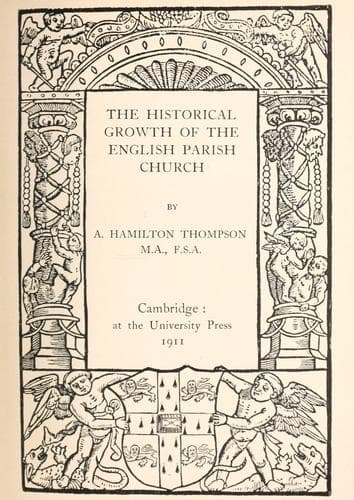
The Historical Growth of the English Parish Church — John Shaqi
The Historical Growth of the English Parish ChurchThompson, A. Hamilton (Alexander Hamilton)
History
The Historical Growth of the English Parish Church
Thompson, A. Hamilton (Alexander Hamilton)
Church architecture -- England
for a dean, six chaplains, four clerks, six choristers, and one
secular clerk. All these foundations bore a distinct resemblance to
the ordinary collegiate bodies, such as those of the cathedrals, or of
Wolverhampton, Tamworth, Bridgnorth, or Westbury-on-Trym. But, while
the holders of prebends in collegiate churches were not necessarily,
and indeed were seldom, resident, the fellows or chaplains of chantry
colleges were obliged to be always on the spot. Nor were these
chantries of more than one priest founded merely in parish churches.
Lords of manors founded chantries on their estates: there was a
college of several chantry priests at the Beauchamp castle of Elmley
in Worcestershire, for example. Sir Robert Umfraville, who founded in
1429 a chantry of a master and a chaplain in the chapel of his manor
house at Farnacres, near Gateshead, strictly bound down the incumbents
to their religious duties, forbidding them to carry on any temporal
business as bailiffs or estate agents, on the ground that _dum colitur
Martha, expellitur Maria_.
§ 17. The foundation of ordinary chantries more than kept pace with
the foundation of chantry colleges. Individual benefactors sought to
secure their own salvation and that of their relations, by endowing an
altar in their parish church. In parishes where services were few, the
parishioners often clubbed together for the support of a stipendiary
service, paid out of property of which they were feoffees. The
chaplain whose services were thus secured would be of great use to the
incumbent of a large parish, especially at seasons when there were many
communicants, and many confessions had to be heard. Also, in distant
parts of large parishes, separated from the mother church by several
miles, or by foul roads and flooded streams in winter, chantry priests
were provided by individual or collective benefactions to serve the
altars of parochial chapels. In the great parishes of west Yorkshire,
Burnsall, Aysgarth, or Grinton, each including a vast tract of dale
and fell, parochial chapels, subject to the mother church, had existed
from a very early period. Such chapels became more numerous as the
middle ages advanced; and the famous chapel of South Skirlaugh, between
Hull and Hornsea, so often quoted as a perfect example of late Gothic
work, was one of these subordinate foundations. It may also be noted
that two of the largest parish churches of the same neighbourhood, St
Augustine's at Hedon and Holy Trinity at Hull, were originally chapels
to Preston-in-Holderness and Hessle. At Boughton in Northants, owing
to a shifting of the population, a chapel in the parish became the
parish church. Obviously, if the larger churches were to be properly
served, they must depend in no small measure on the goodwill of the
parishioners.
Public-domain text, read in full here on John Shaqi.
Reviews
Reviews
No reviews yet
Be the first to share your thoughts on this work.
Join the Discussion
Join the discussion
Sign in to leave a comment or review.
Sign InorCreate an account