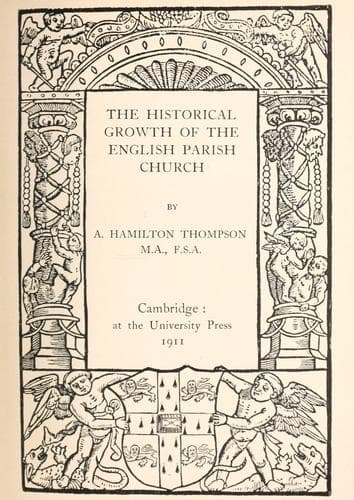
The Historical Growth of the English Parish Church — John Shaqi
The Historical Growth of the English Parish ChurchThompson, A. Hamilton (Alexander Hamilton)
History
The Historical Growth of the English Parish Church
Thompson, A. Hamilton (Alexander Hamilton)
Church architecture -- England
§ 18. In the fourteenth and fifteenth centuries the parishioners came
forward with benefactions as they never had done before. The rich wool
stapler of Grantham, Newark, or Boston, returned thanks for his wealth
by founding a chantry in his church or one of its chapels. With the
rise of the commercial class, the churches of East Anglia were rebuilt
and transformed. Wealthy trade guilds at York, Boston, Shrewsbury,
or Coventry, maintained their own chaplains in the various parish
churches. Religious guilds or fraternities, composed both of men and
women, obtained royal licence for incorporation, and established their
chantries. Such was the Palmers' guild at Ludlow, which received its
first royal charter in 1284, and maintained a large body of chantry
priests, incorporated as a college, in the parish church. These
religious guilds existed for the purpose of mutual assistance and works
of charity. The guilds of St Mary and Corpus Christi in Cambridge
united together in one corporation, and founded Corpus Christi college
in 1352. In 1392 the guild of St Mary at Stamford had licence to
devote land to the maintenance of certain chantry priests in St Mary's
at the Bridge. In the same year, two guilds at Coventry were united
under the name of the guild of the Holy Trinity, St Mary, and St John
the Baptist, and founded a college of chaplains in St John's chapel
at Bablake. Still in 1392, the guild of the Holy Cross at Birmingham
was founded, with its chaplains in St Martin's; and the guilds of St
Mary and of Jesus Christ and the Holy Cross in the parish church of
Chesterfield. To 1393 belongs the foundation of the guild of the Holy
Trinity at Spalding, with a chaplain at the Trinity altar in the parish
church. In the reign of Henry IV the refounded guild of St Cross and
St John the Baptist at Stratford-on-Avon had licence to find two or
more chaplains in their parish church (1403); the guild of St Thomas
of Canterbury, with one or two chaplains, was founded at Long Sutton
in Lincolnshire (1405). Under Henry VI may be mentioned the guild of
St Mary at Louth, with more than one chaplain, founded in 1446-7; the
licence to the guild of the Holy Trinity at Nottingham, in the same
year, to maintain two chaplains in St Mary's church; the guild of St
Mary of Crediton, with a chaplain at the altar of St Peter, founded in
1448; the guilds of the Holy Trinity, with two chaplains, at Chipping
Norton, and, with one or more chaplains, at Louth (1450); and the guild
of St Mary, with two chaplains, at Chipping Sodbury in Gloucestershire
(1452). In 1460-1, the twelve chaplains, supported by seven guilds,
in All Saints, Northampton, were formed into a college. In the time
of Edward IV the trade guilds became more active in establishing
chantries; but the foundation of religious guilds went on with unabated
zeal. A number were founded in the small market-towns of Bedfordshire,
Buckinghamshire, and Hertfordshire, with aid in more than one instance
Public-domain text, read in full here on John Shaqi.
Reviews
Reviews
No reviews yet
Be the first to share your thoughts on this work.
Join the Discussion
Join the discussion
Sign in to leave a comment or review.
Sign InorCreate an account