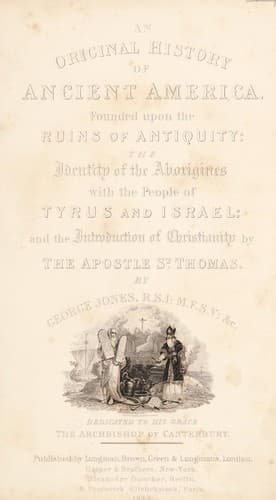
The History of Ancient America, Anterior to the Time of Columbus: Proving the Identity of the Aborigines with the Tyrians and Israelites; and the Introduction of Christianity into the Western Hemisphere By The Apostle St. ThomasJones, George
History
The History of Ancient America, Anterior to the Time of Columbus: Proving the Identity of the Aborigines with the Tyrians and Israelites; and the Introduction of Christianity into the Western Hemisphere By The Apostle St. Thomas
Jones, George
America -- Antiquities; America -- Discovery and exploration -- Phoenician; Indians -- Origin
The reader will excuse the relation of an anecdote, to which may be
traced the production of the present work. At the early age of nine
years, a small ancient coin came into the accidental possession of the
writer; its stamp and character were enveloped in mystery, and
recourse was had to an antiquary to decipher them. The obverse of the
coin contained a profile head, and around it the letters {AVGVSTVS}: on
the reverse, a Temple with the doors closed, surmounted by the word
{PROVIDENTIA}. The explanation was as follows: viz.--A coin of Augustus
Cæsar--the Temple was that of Janus, the doors of which had been
_open_ for nearly two centuries, as emblematical of the continuance of
Roman warfare with foreign countries; but on the coin the doors were
_closed_, and with the word of thanksgiving, were symbolical of
universal peace, thus proving that the coin was struck the very year
in which the Saviour was born! Thus upon one coin were illustrated the
features of the second Roman Emperor,--Mythology, Cessation of
War,--the downfall of Brutus and Cassius,--the defeat of Anthony,--and
the Birth of Christianity! This simple incident made so powerful an
impression upon the boyhood of the relator, that to it he has always
traced the foundation of his Scriptural, Historical, and Poetical
studies, together with an enthusiastic devotion to the Fine Arts.
The description of the above coin will illustrate the historical
intelligence to be derived from their perusal. A medal is an especial
mode of recording tributary honour to individuals--literary, civil, or
military;--they become heirlooms in family possessions, and are
transmitted from sire to son, as absolute records of their ancestors'
fame. They are also struck in celebration of national events, and
thence become records of a people. So assured was Napoleon of this,
that a series of his medals are a complete history of his victories,
from his Consulate to his loss of the Empire; and that event at
Waterloo was recorded by Great Britain upon her medals, for even the
soldiers as well as officers. Denon of France, and Wyon of England,
are names as artists worthy to record the victories of Napoleon and
Wellington.
Architecture, Sculpture, Paintings, Coins, and Medals, from the
investigation contained in the previous pages (we submit to the
judgment of the reader), are established as authorities for historical
records.
SECTION IV.
ENGRAVED GEMS.
Public-domain text, read in full here on John Shaqi.
Reviews
Reviews
No reviews yet
Be the first to share your thoughts on this work.
Join the Discussion
Join the discussion
Sign in to leave a comment or review.
Sign InorCreate an account