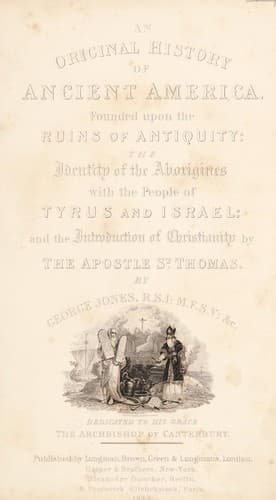
The History of Ancient America, Anterior to the Time of Columbus: Proving the Identity of the Aborigines with the Tyrians and Israelites; and the Introduction of Christianity into the Western Hemisphere By The Apostle St. ThomasJones, George
History
The History of Ancient America, Anterior to the Time of Columbus: Proving the Identity of the Aborigines with the Tyrians and Israelites; and the Introduction of Christianity into the Western Hemisphere By The Apostle St. Thomas
Jones, George
America -- Antiquities; America -- Discovery and exploration -- Phoenician; Indians -- Origin
This is a branch of the Fine Arts, the most ancient in practice--or
that is mentioned in history, sacred or profane; and although gems are
not received like coins or medals, as conclusive proofs of events, yet
they cannot be rejected on the score of doubtful antiquity. Seals and
signet-rings are of course included in the term "engraved gems," and
they bear the heraldic arms of family honours, their names and actions
are traceable, and thus they illustrate the chivalric dignities of the
original owners. The style of ancient art (even without a date to the
gem) will carry the inquiring mind to the æra of the artist, and
thence establish at least the century in which they were engraved.
Of the antiquity of gem engraving, the Bible bears conclusive
evidence. In the graphic description of the priestly garments of
Aaron, [Exodus xxviii.] it states that the shoulder ornaments of the
Ephod are to be engraved stones, each containing six of the names of
the Tribes of Israel. "And thou shalt take two onyx stones and _grave_
on them the names of the Children of Israel: six of their names on one
stone, and the other six names of the rest on the other stone,
according to their birth. With the work of _an engraver_ in stone,
_like the engravings of a signet_, shalt thou _engrave_ the two stones
with the names of the Children of Israel," &c. (verses 9, 10, and 11.)
Aaron's "breastplate of judgment" was to contain twelve precious
stones or gems, each stone to have engraved upon it the name of a
Tribe of Israel. "And thou shalt set in it settings of stones, even
four rows of stones: the first row shall be a sardius (_i. e._ ruby),
a topaz, and a carbuncle: this shall be the first row. And the second
row shall be an emerald, a sapphire, and a diamond. And the third row
a ligure, an agate, and an amethyst. And the fourth row a beryl, and
an onyx, and a jaspar: they shall be set in gold in their enclosings.
And the stones shall be with the names of the Children of Israel,
twelve, according to their names, _like the engravings of a signet_:
every one with his name shall they be according to the twelve tribes."
(v. 17--21.)
The gold mitre for the High Priest is thus described: "And thou shalt
make a plate of pure gold, and grave upon it, like _the engravings of
a signet_--HOLINESS TO THE LORD"--(v. 36). From the triplicated
sentence in the above quotations--viz., "like the engravings of a
signet," it is proved that gem engraving was practised _anterior_ to
the time of Aaron, who officiated 1491 years before Christ. The great
antiquity, therefore, of sculptured gems, will not be questioned; and
their mottoes, ciphers, or style of art, may speak of a people, their
epochs, or their progress in civilization.
Reviews
Reviews
No reviews yet
Be the first to share your thoughts on this work.
Join the Discussion
Join the discussion
Sign in to leave a comment or review.
Sign InorCreate an account