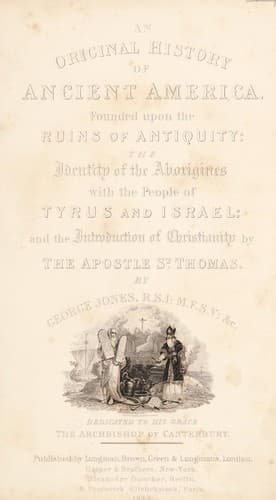
The History of Ancient America, Anterior to the Time of Columbus: Proving the Identity of the Aborigines with the Tyrians and Israelites; and the Introduction of Christianity into the Western Hemisphere By The Apostle St. ThomasJones, George
History
The History of Ancient America, Anterior to the Time of Columbus: Proving the Identity of the Aborigines with the Tyrians and Israelites; and the Introduction of Christianity into the Western Hemisphere By The Apostle St. Thomas
Jones, George
America -- Antiquities; America -- Discovery and exploration -- Phoenician; Indians -- Origin
In the development of the present work, every branch of the Fine Arts
will be brought forward to uphold and substantiate this Tyrian
Æra--they having all obtained in the Western hemisphere previous to
the time of Columbus,--which period (anterior to the Genoese, 1492, A.
D.) is contemplated by the new historic term--_Ancient America_.
CHAPTER V.
THE DISCOVERIES OF THE RUINED CITIES IN MEXICAN AMERICA--THEIR
GENERAL CHARACTER AND GEOGRAPHICAL LOCALITIES--THE DESCRIPTIONS
OF THE RUINS ANALYZED, &c.
SECTION I.
THE DISCOVERERS AND EXPLORERS OF THE RUINS--DATE AND
LOCALITY--PAINTINGS--MAPS AND CHARTS, &c.
In the preceding chapter, it is stated that the Fine Arts will be used
as strong evidences towards the development of this epoch, and that
they will be received as records. They represent what will be wanted
in illustrating the Aborigines of the North--viz., _the lex
scripta_--for Sculpture and Paintings must be regarded only as a more
concise and impressive manner of writing. Since, therefore, Sculpture
is one of the powers conjoined with Architecture to enable us to raise
our historical edifice, it is necessary to prove the existence of our
strength in the country illustrated--to prove that Ancient Cities have
been discovered--that temples and palaces have been recovered from the
depths of the forest, and that, too, in that part of America now
under consideration, having reference to the Aborigines _not_ of the
North. These investigations are required for the reader who may not
have read "The Incidents of Travel in Central America," and even those
that have, will expect an analysis or review of the discovered Ruins;
it is also demanded by the character of this work, for it is essential
to establish their existence before they can be produced as witnesses
to support an historic argument; and like a legal document, parole
evidence will not be received if the document itself can be produced.
Paintings also are a portion of the evidence to sustain our novel
history. The paintings of Mexican America, though rude, contain proofs
of progressive ages, whereby facts may be gathered, supported by
traditions, to authorize the formation of a chronological arrangement
of events. These pictorial efforts of art are on cloth of unusual
thickness, in order to secure stability--for the Mexicans had no other
written records--but, to which may now be added from the late
discoveries--Sculpture. The paintings, it has been stated, were rude,
and not unlike those of ancient Egypt; and like those of the Nile, a
symbol stood for whole sentences, or parts of history,--and does not
the same method exist with European art? A cross represents the
Crucifixion! It is in this manner that the paintings of ancient Mexico
must be translated. The colouring was far beyond the Egyptian in
regard to brilliancy and variety--an important point in proving a
Tyrian analogy.
Reviews
Reviews
No reviews yet
Be the first to share your thoughts on this work.
Join the Discussion
Join the discussion
Sign in to leave a comment or review.
Sign InorCreate an account