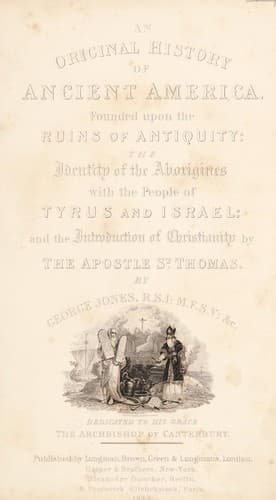
The History of Ancient America, Anterior to the Time of Columbus: Proving the Identity of the Aborigines with the Tyrians and Israelites; and the Introduction of Christianity into the Western Hemisphere By The Apostle St. ThomasJones, George
History
The History of Ancient America, Anterior to the Time of Columbus: Proving the Identity of the Aborigines with the Tyrians and Israelites; and the Introduction of Christianity into the Western Hemisphere By The Apostle St. Thomas
Jones, George
America -- Antiquities; America -- Discovery and exploration -- Phoenician; Indians -- Origin
"There are no remains in Copan of palaces or private dwellings, and
the principal part (of the ruins) is that which stands on the bank of
the river, and may perhaps with propriety be called the Temple. The
Temple is an oblong enclosure. The front or river wall ('stone and
nearly _one hundred feet high_,' vol. i., p. 95) extends on a right
line, North and South, _six hundred and twenty-four feet_, and it is
from _sixty_ to _ninety feet in height_." The difference in height
arising from several parts having fallen. "It (the river-wall) is made
of _cut stone_, from three to six feet in length, and a foot and a
half in breadth. In many places the stones have been thrown down by
bushes growing out of the crevices. The other three sides consist of
ranges of steps and _pyramidal_ structures, rising from _thirty, to
one hundred and forty feet_ on a slope. The whole line of survey (of
this Temple) is _two thousand eight hundred and sixty-six feet_, which
though gigantic and extraordinary for a ruined structure of the
Aborigines, _that the reader's imagination may not mislead him_, I
consider it necessary to say, _is not so large_ as the great
(Egyptian) Pyramid of Ghizeh."
We certainly do not desire to be misled, or _our_ readers
either,--therefore, at once, will be compared the measurements of the
pyro-temple of Copan, and the Pyramid of Egypt. Lee Bruyn gives the
base side of the great edifice of the Nile at 750 feet. Greaves states
it to be 693 feet; the difference between these computations is
fifty-seven feet, which divided for an average, and added to the
lesser sum, will shew one side to be 721 feet (and a fraction), which
multiplied by four, the sum total of the entire square base will be
2884 feet,--that of Copan--viz., 2866 feet, will leave only a
difference between the great Pyramidal Edifices in Egypt and Copan of
_eighteen feet_! but from diversity in measurement they may be viewed
as the fac-similes of each other in regard to the base. This cannot
be accidental. Taking Greaves's numbers, each side 693 × 4 = 2772
feet. Stephens's sum total of Copan is 2866, leaving an increase in
size over that of the Egyptian of ninety-four feet! Mr. Stephens may,
perhaps, have forgotten the measurements in Egypt, although he has
travelled there; but we shall have occasion to refer to the ingenious
manner in which he endeavours to stay the "imagination" of his readers
upon the subject of all the Ruins.
The comparative measurements have been brought forward, that the
reader may not be misled in reading this work.
Public-domain text, read in full here on John Shaqi.
Reviews
Reviews
No reviews yet
Be the first to share your thoughts on this work.
Join the Discussion
Join the discussion
Sign in to leave a comment or review.
Sign InorCreate an account