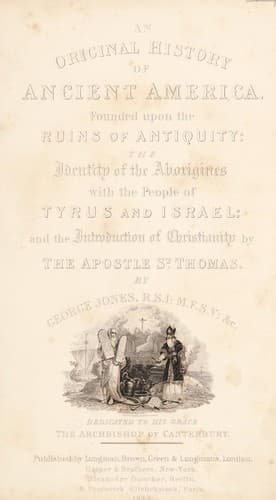
The History of Ancient America, Anterior to the Time of Columbus: Proving the Identity of the Aborigines with the Tyrians and Israelites; and the Introduction of Christianity into the Western Hemisphere By The Apostle St. ThomasJones, George
History
The History of Ancient America, Anterior to the Time of Columbus: Proving the Identity of the Aborigines with the Tyrians and Israelites; and the Introduction of Christianity into the Western Hemisphere By The Apostle St. Thomas
Jones, George
America -- Antiquities; America -- Discovery and exploration -- Phoenician; Indians -- Origin
Another singular coincidence (we may remark) occurs in the measurement
of the terraced-pyramid at Mexican Cholula; the base of that is 5760
feet!--now the base of the Egyptian, as shewn above, is 2884 feet
only; this sum multiplied by two, produces a sum total of 5768; a
difference only of _eight feet_, would make the Pyramid of Cholula
_exactly twice_ as large as that of Egypt. An error may have occurred
in reference to the eight feet--for in so large a measurement, and by
different authors, it is but natural that an error might arise, and
consequently these bases, as to size, cannot be viewed as accidental.
"Near the South-west corner of the river-wall, and the South-wall, is
a recess, which was probably once occupied by _a colossal monument_
fronting the water--no part of which is now visible. Beyond are the
remains of _two small pyramidal structures_, to the largest of which
is attached a wall running along the west bank of the river. This
appears to have been one of the principal walls of the city, and
between the _two pyramids_ there seems to have been a gateway or
principal entrance from the water. The South wall runs at right angles
to the river, beginning with a range of steps about thirty feet high,
and each step about eighteen inches square. At the South-east corner
is _a massive pyramidal structure_ one hundred and twenty feet high on
the slope. On the right are other remains of terraces and _pyramidal
buildings_, and here, also, was probably a gateway, by a passage about
twenty feet wide, into a quadrangular area two hundred and fifty feet
square, _two sides of which are massive pyramids_ one hundred and
twenty feet on the slope. At the foot of these structures, and at
different parts of the quadrangular area, are numerous remains of
_sculpture_, especially a _colossal monument, richly sculptured_,
fallen and ruined. Behind it _fragments of sculpture_, thrown down
from their places by trees, are strewed and lying loose _on the side
of the pyramid, from the base to the top_. 'Idols' give a peculiar
character to the ruins of Copan. One stands with its face _to the
East_ [_i. e._ to the Rising Sun] about six feet from the base of the
pyramidal wall. It is _thirteen feet high, four feet in front and
back_, and _three feet on the sides_ [_i. e._ four-sided column]
_sculptured on all four of its sides, from the base to the top_, and
one of the richest and most elaborate specimens in the whole extent of
ruins. Originally, it was _painted_, the marks of _red colour_ being
distinctly visible. Before it at the distance of about eight feet, is
a large block of sculptured stone, which the Indians call an altar.
The subject of the front [_i. e._ of the Idol-obelisk] is a
full-length figure, the face wanting beard, and of a feminine cast,
though the dress seems that of a man. On the two sides are rows of
_hieroglyphics_ [_i. e._ the sacred or religious language] which
probably recite the history of this mysterious personage. Following
Public-domain text, read in full here on John Shaqi.
Reviews
Reviews
No reviews yet
Be the first to share your thoughts on this work.
Join the Discussion
Join the discussion
Sign in to leave a comment or review.
Sign InorCreate an account