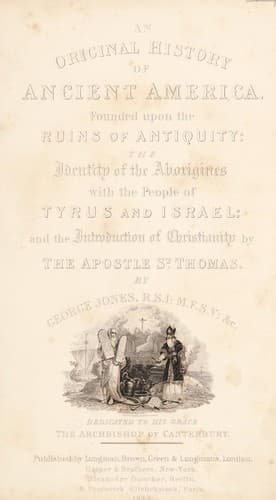
The History of Ancient America, Anterior to the Time of Columbus: Proving the Identity of the Aborigines with the Tyrians and Israelites; and the Introduction of Christianity into the Western Hemisphere By The Apostle St. ThomasJones, George
History
The History of Ancient America, Anterior to the Time of Columbus: Proving the Identity of the Aborigines with the Tyrians and Israelites; and the Introduction of Christianity into the Western Hemisphere By The Apostle St. Thomas
Jones, George
America -- Antiquities; America -- Discovery and exploration -- Phoenician; Indians -- Origin
"The piers (_i. e._ the square columns of the Temple) which are still
standing, contained other figures of the same general character, but
which unfortunately are more mutilated, and from the declivity of the
terrace it was difficult to set up the _camera lucida_ in such a
position as to draw them. The piers which are fallen were no doubt
enriched with the same ornaments. _Each one_ had a specific meaning,
_and the whole probably presented some allegory or history_, and when
entire and painted, the effect in ascending the terrace must have been
imposing and beautiful."
This "allegory or history" we have endeavoured to decipher in the
Analogies. The sculpture of this Temple, like the metopes of the
Parthenon, should not be viewed in separate parts, but as a whole; for
the parts, like single letters, are useless in themselves, but when
placed together in proper and consecutive localities, they instantly
express a word, or sentences, and thence convey to the mind the full
intelligence of the subject.
"The tops of the doorways are all broken. They had evidently been
square, and over one were large niches in the wall on each side, in
which the lintels had been laid. The lintels had been all fallen, and
the stones above formed broken natural arches [angles?]. Underneath
were heaps of rubbish, but there were no remains of lintels. If they
had been single slabs of stone, some of them must have been visible
and prominent, and we made up our minds _that the lintels had been of
wood_, and perhaps we should not have ventured the conclusion, but for
the _wooden lintel_ which we had seen over the doorway at Ocosingo,
and by what we saw afterwards in Yucatan (Uxmal), we were confirmed
beyond _all doubt_ in our opinion. I do not conceive, however, that
_this gives any conclusive data_ in regard to the age of the
buildings. The wood (lintels) if such as we saw in the other places
(_i. e._ Ocosingo and Uxmal) would be very lasting, its decay must
have been extremely slow, and _centuries_ may have elapsed since it
perished altogether."
The decaying of the lintels at Ocosingo and Palenque, and their
existence and _preservation_ at Uxmal enables a data to be formed in
reference to the order of their erection; for the _non-appearance_ of
any wooden lintels at Copan authorizes the placing of that city first
in chronological order, followed by the cities of Ocosingo and
Palenque, and from the argument, and the preservation of the wood,
Uxmal was built _after_ the foregone.
"The building has two parallel corridors running lengthwise _on all
four of its sides_. In front these corridors are about nine feet wide,
and extend the whole length of the building, upwards of two hundred
feet. In the long wall that divides them there is but one door, which
is opposite the principal door of entrance, and has a corresponding
one on the other side, leading to a courtyard in the rear.
Reviews
Reviews
No reviews yet
Be the first to share your thoughts on this work.
Join the Discussion
Join the discussion
Sign in to leave a comment or review.
Sign InorCreate an account