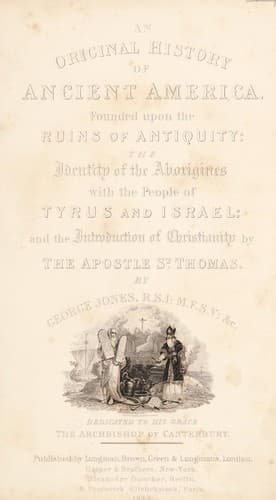
The History of Ancient America, Anterior to the Time of Columbus: Proving the Identity of the Aborigines with the Tyrians and Israelites; and the Introduction of Christianity into the Western Hemisphere By The Apostle St. Thomas — John Shaqi
The History of Ancient America, Anterior to the Time of Columbus: Proving the Identity of the Aborigines with the Tyrians and Israelites; and the Introduction of Christianity into the Western Hemisphere By The Apostle St. ThomasJones, George
History
The History of Ancient America, Anterior to the Time of Columbus: Proving the Identity of the Aborigines with the Tyrians and Israelites; and the Introduction of Christianity into the Western Hemisphere By The Apostle St. Thomas
Jones, George
America -- Antiquities; America -- Discovery and exploration -- Phoenician; Indians -- Origin
"_The floors are of cement_, as hard as the best seen in the remains
of Roman baths and cisterns. The walls are about ten feet
high,--_plastered_,--and on each side of the principal entrance
ornamented with _medallions_, of which the borders only
remain,--these perhaps contained the busts of the Royal family. The
separating-wall had apertures of about a foot, probably intended for
purposes of ventilation. _The builders were evidently ignorant of the
principle of the_ ARCH, and the support (ceiling) was made by stones
(blocks) lapping over as they rose, as at Ocosingo, and as among the
Cyclopean remains in Greece and Italy." * * * * "From the centre door
of this corridor a range of stone steps, thirty feet long, leads to a
rectangular courtyard, eighty feet long by seventy broad. On each side
of the steps are grim and gigantic figures _carved on stone_ in _basso
relievo_, nine or ten feet high, and in a position slightly inclined
backward, from the end of the steps to the floor of the corridor. They
are adorned with head-dresses and necklaces, _but their attitude is
that of pain and trouble_. The design and anatomical proportion of the
figures are faulty, but there is a force of expression about them
which shews _the skill and conceptive power of the artist_. On each
side of the courtyard of the Palace (Temple) are divided apartments,
probably for sleeping. (?) On the right, the piers have all fallen
down. On the left they are still standing and ornamented with _stucco
figures_. In the centre apartment, in one of the holes, are the
remains of a _wooden pole_, about a foot long, which once stretched
across, but the rest had decayed. It was the only piece of wood
(worked) we found at Palenque, and we did not discover this until some
time after we had made up our minds in regard to the wooden lintels
over the doors. It was much worm-eaten, and probably in a few years
not a vestige will be left. At the farther side of the courtyard was
another flight of stone steps, corresponding with those in front, on
each side of which are carved figures, and on the flat surface between
are single _cartouches of hieroglyphics_." * * * * * * "In the further
corridor the wall was in some places broken, and _had_ SEVERAL
_separate coats of plaister and paint_. [Proofs of different periods]
In _one place we counted six layers, each of which had the remains of
colours_. This corridor opened to a second courtyard, eighty feet
long, and but thirty across. The floor of the corridor was ten feet
above that of the courtyard, and on the wall underneath were _square
stones_ with _hieroglyphics sculptured_ upon them. On the piers were
_stuccoed figures_, but in a ruined condition. On the other side of
the courtyard were two ranges of corridors, which terminated the
building in this direction. The first of them is divided into three
apartments, with doors opening from the extremities upon the western
corridor. All the piers are standing excepting that on the north-west
Public-domain text, read in full here on John Shaqi.
Reviews
Reviews
No reviews yet
Be the first to share your thoughts on this work.
Join the Discussion
Join the discussion
Sign in to leave a comment or review.
Sign InorCreate an account