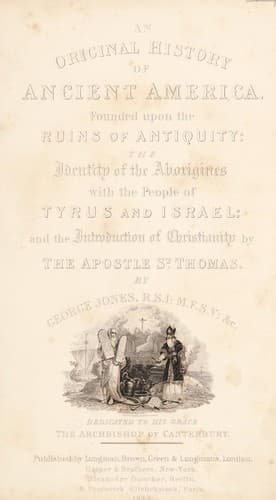
The History of Ancient America, Anterior to the Time of Columbus: Proving the Identity of the Aborigines with the Tyrians and Israelites; and the Introduction of Christianity into the Western Hemisphere By The Apostle St. Thomas — John Shaqi
The History of Ancient America, Anterior to the Time of Columbus: Proving the Identity of the Aborigines with the Tyrians and Israelites; and the Introduction of Christianity into the Western Hemisphere By The Apostle St. ThomasJones, George
History
The History of Ancient America, Anterior to the Time of Columbus: Proving the Identity of the Aborigines with the Tyrians and Israelites; and the Introduction of Christianity into the Western Hemisphere By The Apostle St. Thomas
Jones, George
America -- Antiquities; America -- Discovery and exploration -- Phoenician; Indians -- Origin
corner. All are covered with _stucco ornaments_, and one with
_hieroglyphics_. The rest contain _figures_ in _bas relief_." * * *
"There are several distinct and independent buildings. [Within the
confines of the Temple] The principal of these is the TOWER, on the
south side of the second court. This Tower is conspicuous by its
height and proportions: the base is thirty feet square, and it has
_three stories_. Entering over a heap of rubbish at the base, we
_found within another Tower, distinct from the outer one_, and a
stone staircase, so narrow that a large man could not ascend it. The
staircase terminates against a dead stone ceiling, closing all further
passage. _The whole Tower was a substantial stone structure_, and in
its arrangements and purposes about as incomprehensible as the
sculptured tablets. East of the Tower is another building, with two
corridors, one richly decorated with _pictures in stucco, and having
in the centre an elliptical tablet_. It is four feet long and three
wide, _of hard stone, set in the wall_, and the SCULPTURE is in _bas
relief_. Around it are the remains of a rich _stucco border_. The
principal figure sits cross-legged (_i. e._ orientally) on a couch,
ornamented with two leopards' heads: the attitude is easy, the
physiognomy the same as that of the other personages, and the
_expression calm and benevolent_. The figure wears around its neck a
necklace of pearls [beads of gold?] to which is suspended a small
medallion containing a face, perhaps for an image of the Sun."
From the positive radii around the medallion (as presented by the
artist) there can be no hesitation in distinctly stating that it was
intended for an "image of the Sun." This is essential in identifying
the analogy of Religious worship: it also gives further authority for
the belief that this edifice was a Temple, and not a Palace. The
_Tower_ of Palenque also aids this belief, for from its locality it
would seem to have been used as a modern oriental minaret, from which
the priests summoned the people to prayer.
"Like every subject of sculpture we had seen in this country, the
personage had earrings, bracelets on the wrists, and a girdle round
the loins. The head-dress differs from most of the others at Palenque
in that it wants the plume of feathers. Near the head are _three
hieroglyphics_. The other figure, which seems that of a woman is
sitting cross-legged [kneeling?] on the ground, richly dressed, and
apparently in the act of _making an offering_. In this supposed
offering is seen a plume of feathers, in which the head-dress of the
principal personage is deficient. Over the head of the sitting
personage are _four hieroglyphics_. _This is the only piece of
Sculptured Stone about the the Palace_ (Temple) except those in the
courtyard. Under it formerly stood a table [altar?] of which the
impression against the wall is still visible."
Reviews
Reviews
No reviews yet
Be the first to share your thoughts on this work.
Join the Discussion
Join the discussion
Sign in to leave a comment or review.
Sign InorCreate an account