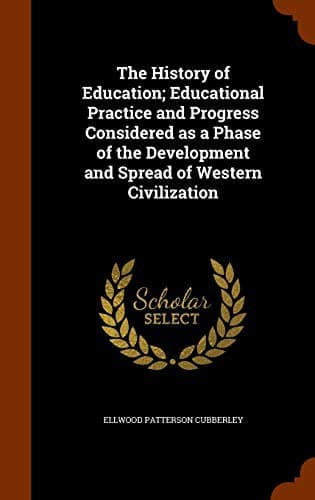
The History of Education: Educational Practice and Progress Considered as a Phase of the Development and Spread of Western CivilizationCubberley, Ellwood Patterson
History
The History of Education: Educational Practice and Progress Considered as a Phase of the Development and Spread of Western Civilization
Cubberley, Ellwood Patterson
Education -- History
The modern elementary vernacular school may then be said to be essentially
a product of the Protestant Reformation. This is true in a special sense
among those peoples which embraced some form of the Lutheran or
Calvinistic faiths. These were the Germans, Moravians, Swedes, Norwegians,
Finns, Danes, Dutch, Walloons, Swiss, Scotch, Scotch-Irish, French
Huguenots, and the English Puritans. As the Renaissance gave a new
emphasis to the development of secondary schools by supplying them with a
large amount of new subject-matter and a new motive, so the Reformation
movement gave a new motive for the education of children not intended for
the service of the State or the Church, and the development of elementary
vernacular schools was the result. Only in England, of all the revolting
countries, did this Protestant conception as to the necessity of education
for salvation fail to take deep root, with the result that elementary
education in England awaited the new political and social and industrial
impulses of the latter half of the nineteenth century for its real
development.
The rise of the questioning and inferring spirit in the Italian
Renaissance marked the beginnings of the transition from mediaeval to
modern attitudes, and one of the most important outgrowths of this was the
rise of scientific inquiry which in time followed. This meant the
application of human reason to the investigation of the phenomena of
nature, with all that this eventually implied. This, slowly to be sure,
turned the energies of mankind in a new direction, led to the substitution
of inquiry and patient experimentation for assumption and disputation, and
in time produced a scientific and industrial revolution which has changed
the whole nature of the older problems. The scientific spirit has to-day
come to dominate all lines of human thinking, and the applications of
scientific principles have, in the past century, completely changed almost
all the conditions surrounding human life. Applied to education, this new
spirit has transformed the instruction and the methods of the schools, led
to the creation of entirely new types of educational institutions, and
introduced entirely new aims and methods and purposes into the educational
process.
Public-domain text, read in full here on John Shaqi.
Reviews
Reviews
No reviews yet
Be the first to share your thoughts on this work.
Join the Discussion
Join the discussion
Sign in to leave a comment or review.
Sign InorCreate an account