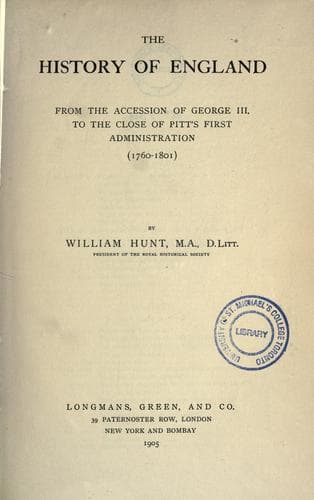
The history of England, from the accession of George III. to the close of Pitt's first administration, 1760-1801Hunt, William
History
The history of England, from the accession of George III. to the close of Pitt's first administration, 1760-1801
Hunt, William
Great Britain -- History -- George III, 1760-1820
A special reason may be discerned for his desire to obtain such an
increase at the end of 1766. The government wanted money; there was a
heavy debt on the civil list, and the navy needed a large grant. An
increase of taxation was inadvisable, for corn was dear. Various schemes
for the increase of revenue were in the air. Many members of parliament,
the court party, the country interest, and the Grenville and Bedford
connexions were regretting the repeal of the stamp act. "We must look to
the East and not to the West," wrote Beckford to Chatham,[75] and he
spoke the mind of his leader. The cabinet was divided. Grafton and
Shelburne agreed with Chatham that the question of the company's rights
should be decided by parliament. Townshend declared that it would be
"absurd" to force the company to share its power with the crown, and
both he and Conway desired that the question of right should be waived
and that its relations with the government should be settled by amicable
arrangement. In May, 1767, the proprietors insisted on a dividend at the
rate of 12-1/2 per cent. A motion was carried to bring the affairs of
the company before parliament. Townshend, as Chatham said, "marred the
business"; he managed to open the door for negotiation, and to make it a
mere matter of money. In June, 1767, a bill was passed, based on an
agreement with the company, which in return for the confirmation of its
territorial revenues, bound itself to pay the government L400,000 a year
for two years; and parliament prohibited a higher dividend than 10 per
cent. The bill was violently opposed, specially by the Rockingham party,
on the ground that it was an unjustifiable interference with the rights
of property. In 1769 the agreement with the company was renewed, and
permission was given for a dividend of 12-1/2 per cent, on certain
conditions. The company was then in debt over L6,000,000.
[Sidenote: _HAIDAR ALI._]
A new and formidable enemy had arisen in Southern India. In 1767 Haidar
(Hyder) Ali, the ruler of Mysore, made war upon the English in
conjunction with the Nizam of Haidarabad. The allies were defeated, and
the nizam made peace. Haidar, however, continued the war. He had a large
force of cavalry which he brought to great perfection, and, as the
English were deficient in that arm, he was able to do much mischief in
the Karnatic. In April, 1769, having previously drawn the English army
away from Madras by skilful manoeuvres, he suddenly appeared in the
immediate neighbourhood of the town. The English were forced to make a
treaty with him on his own terms. The news sent the company's stock down
60 per cent. The same year the crops failed in Bengal, and in 1770 there
was a grievous famine which is said to have carried off a third of the
inhabitants. Yet in spite of the decreasing revenue and the heavy debts
of the company, the proprietors were receiving dividends of 12 and
12-1/2 per cent.
FOOTNOTES:
[68] _Newcastle's Narrative_, p. 11.
Public-domain text, read in full here on John Shaqi.
Reviews
Reviews
No reviews yet
Be the first to share your thoughts on this work.
Elsewhere in the archive
Join the Discussion
Join the discussion
Sign in to leave a comment or review.
Sign InorCreate an account