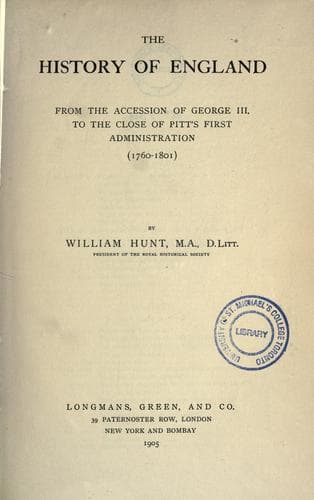
The history of England, from the accession of George III. to the close of Pitt's first administration, 1760-1801Hunt, William
History
The history of England, from the accession of George III. to the close of Pitt's first administration, 1760-1801
Hunt, William
Great Britain -- History -- George III, 1760-1820
[69] _Annual Register_, viii. (1765), 92.
[70] _Bedford Correspondence_, iii., 281; Walpole, _Letters_, iv.,
365-66.
[71] _Annual Register_, xxi. (1778), 256.
[72] Lord Charlemont to Flood, Jan. 8, 1766, _Letters to Flood_, p. 5.
[73] Conway to Lord Hertford, Feb. 12, 1766, in a MS. collection of
Conway's letters, to which Messrs. Sotheran kindly gave me access.
[74] Conway to Hertford, April 29, 1766, MS. Sotheran, _u.s._
[75] Beckford to Chatham, Oct. 15, 1766, MS. Pitt Papers, 19; _Grenville
Papers_, iii., 336.
CHAPTER V.
GROWTH OF THE KING'S POWER.
While Chatham was suffering from gout and Conway from indecision,
Townshend had opportunities for mischief. His brilliant wit and oratory
gave him extraordinary influence in the house of commons, which he used
merely for his own ends, for he was unprincipled and greedy for
popularity. Whatever it might be that the majority in the house wished
to have done, he was anxious to be the doer of it. This desire to lead
the house by carrying out its wishes was probably the true reason of his
opposition to Chatham's Indian policy. It led him to take a more
disastrous line with reference to America. The colonies were irritated
and suspicious. Massachusetts was encroaching on the royal prerogative
by passing an amnesty bill, and was quarrelling over it with its
governor, Bernard, and the New York assembly was defying the authority
of parliament by refusing to provide the troops with certain articles
specified in the mutiny act. An equally unconciliatory spirit prevailed
in England, where the repeal of the stamp act had become unpopular. It
was necessary to keep a permanent force in America, and the colonists
should have been willing to contribute to the defence of the empire by
paying for it. Their refusal was attributed to a desire to save their
pockets, which to some extent was the case, and Englishmen were angry at
the prospect of being called upon to meet expenses which should have
been borne by others. Even warm friends of the colonies held that a
military establishment should be paid for out of colonial revenues, and
Shelburne was considering how a fund might be raised without
taxation.[76] Unfortunately, Townshend chose to pander to the feelings
of the majority of the commons. In a debate on the army supplies on
January 26, 1767, he boasted, without any previous consultation with his
fellow-ministers, that he could raise a revenue from America nearly
sufficient to maintain the troops there. The house received his words
with applause, his colleagues with dumb dismay. Grenville and Lord
George Sackville took them up and forced him to pledge himself to make
them good.
[Sidenote: _AMERICAN REVENUE ACTS._]
Public-domain text, read in full here on John Shaqi.
Reviews
Reviews
No reviews yet
Be the first to share your thoughts on this work.
Elsewhere in the archive
Join the Discussion
Join the discussion
Sign in to leave a comment or review.
Sign InorCreate an account