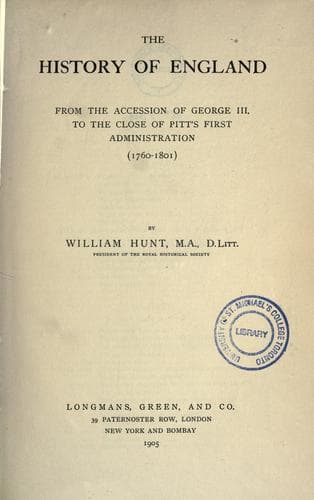
The history of England, from the accession of George III. to the close of Pitt's first administration, 1760-1801Hunt, William
History
The history of England, from the accession of George III. to the close of Pitt's first administration, 1760-1801
Hunt, William
Great Britain -- History -- George III, 1760-1820
The city reformers seized the opportunity of renewing their quarrel with
the house. Wheble and Thompson were collusively arrested and were
discharged, Wheble by alderman Wilkes and Thompson by alderman Oliver,
as not being accused of any crime. Worse was to come. Miller was
arrested by a messenger of the house, and gave the messenger in charge
for assaulting him. Both were brought before Brass Crosby, the lord
mayor, Wilkes, and Oliver; Miller was discharged, the messenger held to
bail. The house ordered Crosby and Oliver, who were both members of it,
to attend in their places, and Wilkes, who was at the bottom of the
affair, at the bar. Wilkes refused to attend unless as member for
Middlesex, and the house, with more discretion than valour, shrank from
another conflict with him. The king, who was deeply interested in the
quarrel, approved; he would, he said, "have nothing more to do with that
devil Wilkes". Crosby and Oliver defended their conduct, and were
committed to the Tower. During the proceedings an angry crowd
interrupted the business of the house, pelted several members, roughly
handled North and Charles Fox, who was conspicuous as a defender of
privilege, and broke their carriages. The lord mayor and Oliver were
visited in the Tower by Rockingham, Burke, and other members of the
opposition. On their release, at the end of the session, on May 8, they
were saluted by the cannon of the artillery company and by vociferous
applause, and the city was illuminated. Proceedings against the
messenger were stopped by the attorney-general. Though the house was
victorious, its dignity suffered so greatly in the conflict that it
forbore to follow up its victory. Burke's words proved true; for though
the publication of debates was still held to be a breach of privilege,
no further attempt was made to punish it. Soon after this dispute with
the house of commons the city reformers quarrelled amongst themselves,
and the party was split up.
[Sidenote: _THE ROYAL MARRIAGE ACT._]
Public-domain text, read in full here on John Shaqi.
Reviews
Reviews
No reviews yet
Be the first to share your thoughts on this work.
Elsewhere in the archive
Join the Discussion
Join the discussion
Sign in to leave a comment or review.
Sign InorCreate an account