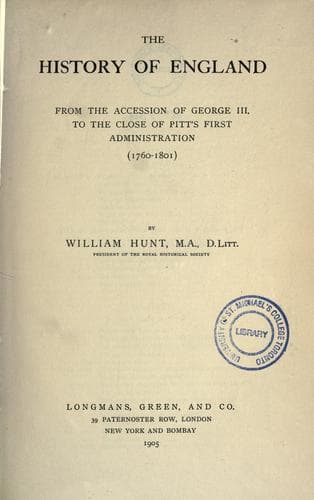
The history of England, from the accession of George III. to the close of Pitt's first administration, 1760-1801Hunt, William
History
The history of England, from the accession of George III. to the close of Pitt's first administration, 1760-1801
Hunt, William
Great Britain -- History -- George III, 1760-1820
Though political disputes dulled the interest excited by theological
questions in the earlier half of the century, the house of commons was
invited on February 6, 1772, to abolish the subscription to the
Thirty-nine Articles which was demanded of all clergymen and of all
students matriculating at Oxford and Cambridge. The movement was
connected with a tendency towards unitarianism, which, besides
attracting many dissenters, exercised an influence within the Church.
Some churchmen seceded; others, less decided, sought to be relieved of
an unwelcome obligation. An association which met at the Feathers
Tavern, in the Strand, sent a petition to the house signed by about two
hundred and fifty men, clergy, doctors, and lawyers, praying to be
relieved of subscription. The king was hostile to the petition, and
North opposed it in moderate terms. Burke spoke against it with
remarkable ability, pointing out that a standard of faith was necessary
to insure order in the Church, and that subscription to the Bible would
not, as the petitioners maintained, afford any criterion of belief. The
petition was rejected by a large majority, though several members on
both sides expressed a dislike to requiring subscription at the
universities from youths who were not of an age to judge of such
matters. The house, though it refused to allow clergymen to evade the
formularies of their Church, was not averse from toleration. A bill to
relieve dissenting ministers and teachers from subscription to certain
of the articles, which was indeed rarely exacted, was carried in the
commons with little opposition, but the king and the bishops were
strongly opposed to it; the royal influence was used against it in the
house of lords, which threw out the bill both in 1772 and 1773, and it
did not become law until six years later.
Public-domain text, read in full here on John Shaqi.
Reviews
Reviews
No reviews yet
Be the first to share your thoughts on this work.
Elsewhere in the archive
Join the Discussion
Join the discussion
Sign in to leave a comment or review.
Sign InorCreate an account