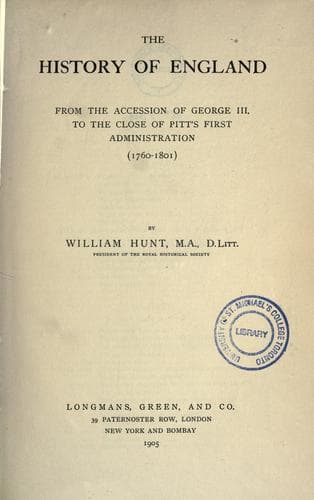
The history of England, from the accession of George III. to the close of Pitt's first administration, 1760-1801Hunt, William
History
The history of England, from the accession of George III. to the close of Pitt's first administration, 1760-1801
Hunt, William
Great Britain -- History -- George III, 1760-1820
The opposition was moribund. An annual motion was made for shortening
the duration of parliaments; but it attracted little attention, and
other questions which had lately agitated men's minds fell equally out
of date. A momentary revival of political excitement was caused by a
bill which affected the king personally. George had family troubles. His
sister Caroline, Queen of Denmark, was accused of adultery and
imprisoned; she was allowed to retire to Hanover, and remained there
until her death. Soon after hearing of her daughter's disgrace the
king's mother died of cancer. She had long ceased to have any political
influence and was eminently charitable, yet the sufferings of her last
days were exulted over by scribblers opposed to the court, and her
funeral was hailed with the cheers of the city mob. About the same time
one of George's brothers, the Duke of Cumberland, after disgracing him
by his flagrant immorality, married Mrs. Horton, the widowed daughter of
Lord Irnham, and sister of Luttrell, the Middlesex member; and the
private marriage of another brother, the Duke of Gloucester, to the
widow of Lord Waldegrave, a bastard daughter of Horace Walpole's
brother, was publicly announced. George was deeply annoyed by these
marriages and forbade the offenders to appear at court. At his wish the
royal marriage bill was laid before parliament. By this act no
descendant of George II. under the age of twenty-six can enter into a
valid marriage without the sovereign's consent; nor above that age,
should the sovereign's consent be withheld, except by giving a year's
notice to the privy council, so that parliament may, if it chooses,
forbid the marriage. The doctrine implied in this act, that the whole
royal family forms a class apart from the rest of the nation, was
foreign to English ideas and smacked rather of German than English
royalty. Yet, whatever the effects of the act may have been on those
most nearly concerned, they have been beneficial to the nation.
Public-domain text, read in full here on John Shaqi.
Reviews
Reviews
No reviews yet
Be the first to share your thoughts on this work.
Elsewhere in the archive
Join the Discussion
Join the discussion
Sign in to leave a comment or review.
Sign InorCreate an account