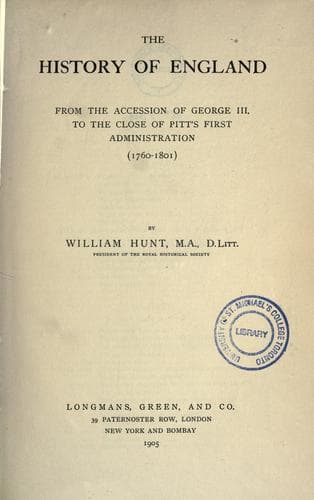
The history of England, from the accession of George III. to the close of Pitt's first administration, 1760-1801Hunt, William
History
The history of England, from the accession of George III. to the close of Pitt's first administration, 1760-1801
Hunt, William
Great Britain -- History -- George III, 1760-1820
The loyalists, or tories as they were called, comprised, in addition to
the royal officers, many of the best and most cultivated people in the
colonies, a majority of the larger landowners, by far the greater number
of the episcopal clergy together with some other religious teachers,
very many physicians, fewer lawyers, though some of the most eminent
among them, and many of the wealthier merchants, who disliked the
interruption of trade and believed that its prosperity depended on
British commerce. Among the lower classes some farmers, mechanics, and
labourers were loyalists. They were weakest in New England, though
fairly numerous in Connecticut. New York was throughout the loyalist
stronghold, and, of the other middle colonies, Pennsylvania was
disinclined to revolution and New Jersey contained a strong loyalist
minority. In the southern colonies they were about as numerous as the
whigs, and in South Carolina and Georgia perhaps outnumbered them. John
Adams, who would be inclined to underestimate their number, thought that
they were a third of the population of the thirteen colonies. The number
on each side fluctuated from time to time; the loyalists claimed to be
in a majority, and it is probable that at least half of the most
respected part of the population were throughout the struggle either
avowedly or secretly averse from revolution.[94] At the lowest
computation 20,000 loyalists joined the British army, and some thirty
regiments or battalions of them were regularly organised and paid. Most
of them were peaceable men, not more inclined for fighting than the
mass of their opponents who were forced into war by an active minority.
Through the skilful management of this minority the loyalists were
disarmed everywhere at the beginning of the struggle. They suffered
terrible persecution. A man suspected of loyalism would be summoned to a
meeting of the "sons of liberty," and ordered to take an oath to them.
If he refused he was tarred and feathered, or set to ride upon a rail,
and his house was defiled with filth. Loyalists were declared liable to
imprisonment, exile, and confiscation. These men were not less patriotic
than the revolutionists; they believed that the welfare of their country
depended on its remaining part of the British empire; and holding this
belief they suffered, fought, and died for their country's sake.
[Sidenote: _A GENERAL ELECTION._]
Public-domain text, read in full here on John Shaqi.
Reviews
Reviews
No reviews yet
Be the first to share your thoughts on this work.
Elsewhere in the archive
Join the Discussion
Join the discussion
Sign in to leave a comment or review.
Sign InorCreate an account