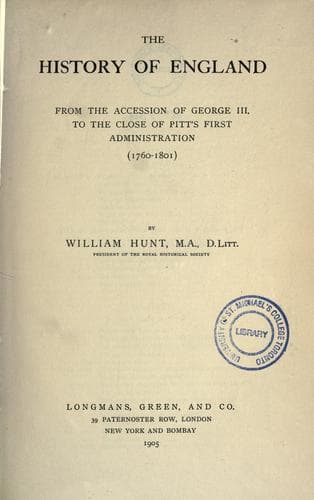
The history of England, from the accession of George III. to the close of Pitt's first administration, 1760-1801Hunt, William
History
The history of England, from the accession of George III. to the close of Pitt's first administration, 1760-1801
Hunt, William
Great Britain -- History -- George III, 1760-1820
Gage found the fortification of Boston Neck no easy matter; the people
would not sell him materials, and somehow his barges sank, his waggons
were bogged, and their loads caught fire. The work was finished at last,
and with his small force he could do little else. In Rhode Island the
people seized the cannon mounted for the defence of the harbour, and in
New Hampshire they surprised a small fort, and carried off ordnance and
stores. Manufactories of arms and powder-mills were set up in different
places. In February, 1775, the Massachusetts provincial congress met,
and urged the militia, and specially the "minute-men"--militiamen ready
to serve on the shortest notice--to perfect their discipline. Virginia,
Maryland, and the Carolinas were astir with warlike preparations; in
Massachusetts men were practising the use of arms on every village
green, a number of Stockbridge Indians were enlisted as minute-men, and
efforts were made to induce the Six Nations to "whet the hatchet"
against the English.[98] Express-riders kept the country people well
supplied with intelligence, in order that they might anticipate any
projected movement of the British troops. On the 26th Gage sent a
detachment to Salem to bring in some guns, but the people removed them
in time. Some opposition was offered to the troops, but they were kept
well in hand and no blood was shed.
[Sidenote: _SKIRMISH AT LEXINGTON._]
He determined to be beforehand at Concord, where the provincials had
gathered a quantity of military stores, and on April 18 sent some
companies of grenadiers and light infantry under Colonel Smith and Major
Pitcairn to destroy them. They went by night up the Charles river in
boats, landed, and began their march. The alarm had been given and the
country was aroused. When they arrived at Lexington at 5 in the morning
of the 19th they found a body of militia on the green. "Disperse, you
rebels!" shouted Pitcairn, and the troops advanced with a cheer. As the
militia dispersed some shots were fired. From which side the first shot
came is not clear. A soldier was hit and Pitcairn's horse was wounded.
The troops fired a volley, a few militiamen were killed and others
wounded, and the soldiers marched on. While the grenadiers were
destroying the stores at Concord a sharp engagement took place with the
militia, and several on both sides were killed and wounded. The troops,
having accomplished their purpose as far as was possible, for part of
the stores had already been removed, set out to return to Boston. As
they marched back, tired and impeded by their wounded, militiamen and
volunteers fired upon them from every hedge, and wall, and house, and
the shots told heavily on their close ranks. Forced on by the ceaseless
fire, like a driven flock of sheep, thick together and helpless, they
staggered back to Lexington, where they arrived completely exhausted.
There they were met by a large detachment under Lord Percy, which had
been sent to their relief.
Public-domain text, read in full here on John Shaqi.
Reviews
Reviews
No reviews yet
Be the first to share your thoughts on this work.
Elsewhere in the archive
Join the Discussion
Join the discussion
Sign in to leave a comment or review.
Sign InorCreate an account