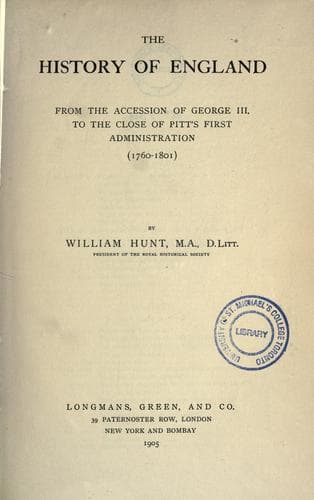
The history of England, from the accession of George III. to the close of Pitt's first administration, 1760-1801Hunt, William
History
The history of England, from the accession of George III. to the close of Pitt's first administration, 1760-1801
Hunt, William
Great Britain -- History -- George III, 1760-1820
After a rest the whole body marched back,
harassed all the way by an incessant fire from cover, which they were
for the most part unable to return. The British loss was sixty-five
killed, about 157 wounded, and a few missing; the American casualties
are stated as ninety-three in all. Not, unhappily, for the last time did
our soldiers find that farmers and the like, who know their country, are
accustomed to shoot, and understand the importance of taking cover, may
be more than a match for brave and disciplined soldiers with no
knowledge of war save the drill of a parade ground. It was evident that
there was fighting stuff in the Americans, that they had some good
marksmen, and that, undisciplined as they were, like the Boers of our
own day, they knew how to use such advantages as they possessed.
Thus was the first blood shed in this long quarrel. The revolution was
begun. Sooner or later it must have come, though the date of its coming
and the violent means by which it was accomplished were decided by
individual action. The spirit which underlay it can be traced with
growing distinctness since 1690; it was a spirit of independence,
puritan in religion and republican in politics, impatient of control,
self-assertive, and disposed to opposition. It was irritated by
restraints on industry and commerce, and found opportunities for
expression in a system which gave the colonies representative assemblies
while it withheld rights of self-government. Great Britain has since
then adopted a more enlightened colonial policy; yet the statesmen of
past times are not to be condemned because they were men of their own
days and lacked the experience of a future age. And it is to be
remembered that England's colonial policy was then, as it is now, the
most liberal in the world. American discontent existed before the reign
of George III.; it was kept in check by the fear of French invasion. It
was when that fear was removed that England began to enforce the
restraints on commerce. This change in policy fell most heavily on the
New England provinces, where whig tendencies were strongest, and
specially on Massachusetts. A small and violent party in the province
fanned the flame of discontent, and the attempts at taxation, which
added to the grievances of the colonists, afforded a respectable cry to
the fomenters of resistance. Their work was aided by the apprehension
aroused in the minds of their fellow-countrymen, by the increase in the
part played by the prerogative, and by the predominance of the tories in
England. While men in other provinces, as Patrick Henry in Virginia,
worked in sympathy with Samuel Adams and his associates, the revolution
was at its outset engineered at Boston, and was immediately determined
by the quarrel between Great Britain and Massachusetts. In the events
which led to the revolution the British government appears to have shown
a short-sighted insistence on legal rights and a contemptuous disregard
Public-domain text, read in full here on John Shaqi.
Reviews
Reviews
No reviews yet
Be the first to share your thoughts on this work.
Elsewhere in the archive
Join the Discussion
Join the discussion
Sign in to leave a comment or review.
Sign InorCreate an account