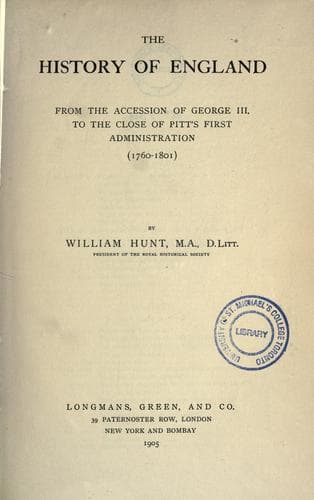
The history of England, from the accession of George III. to the close of Pitt's first administration, 1760-1801 — John Shaqi
The history of England, from the accession of George III. to the close of Pitt's first administration, 1760-1801Hunt, William
History
The history of England, from the accession of George III. to the close of Pitt's first administration, 1760-1801
Hunt, William
Great Britain -- History -- George III, 1760-1820
George was in many respects worthy of their welcome. Moral in his
conduct and domestic in his tastes, he set an example of sobriety and
general decency of behaviour. He was kind-hearted and had the gift of
pleasing. On public occasions his demeanour and words were dignified. In
private he talked in a homely way, his words following one another too
quickly and sometimes showing a confusion of thought and excitability of
brain. To the poor he would speak with familiar kindness, chatting with
them like a good-natured squire. Yet simple as he was in his habits and
private talk, he always spoke and acted as a gentleman; the coarseness
of the old court was a thing of the past. He was deeply and unaffectedly
pious, and was strongly attached to the Church of England; his religion
was of a sober kind and was carried into his daily life. He was
constantly guided by the dictates of his conscience. His will was
strong; and as his conscience was by no means always so well-informed as
he believed it to be, his firmness often deserved the name of obstinacy.
Nor, in common with the best of men, did he always clearly distinguish
between his personal feelings and conscientious convictions. He had
great self-control, and was both morally and physically courageous.
Though as a youth he had been idle, he was never addicted to pleasure;
his accession brought him work which was congenial to him, he overcame
his natural tendency to sloth and, so long as his health allowed,
discharged his kingly duties with diligence. His intellectual powers
were small and uncultivated, but he had plenty of shrewdness and common
sense; he showed a decided ability for kingcraft, not of the highest
kind, and gained many successes over powerful opponents. The welfare of
his people was dear to him; he was jealous for the honour of England,
rejoiced in her prosperity, and strove with all his strength to save her
from humiliation. In religion, tastes, and prejudices he was in sympathy
with the great mass of his people; and in matters in which his policy
and conduct seem most open to censure, he had the majority of the nation
with him.
Public-domain text, read in full here on John Shaqi.
Reviews
Reviews
No reviews yet
Be the first to share your thoughts on this work.
Join the Discussion
Join the discussion
Sign in to leave a comment or review.
Sign InorCreate an account