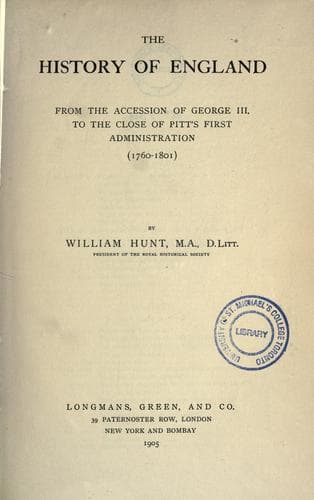
The history of England, from the accession of George III. to the close of Pitt's first administration, 1760-1801Hunt, William
History
The history of England, from the accession of George III. to the close of Pitt's first administration, 1760-1801
Hunt, William
Great Britain -- History -- George III, 1760-1820
He had, however, some serious failings which brought trouble both on his
people and himself. They were largely the results of his training. His
father, Frederick, Prince of Wales, a fool, a fribble and worse, died
when George was twelve years old. His mother, the Princess Augusta, was
a woman of strong will, ambitious of power, unamiable in temper,
thoroughly insincere, narrow-minded, and full of petty feelings. She was
strict in all religious matters, had a high sense of duty, and was a
careful mother. When her son became king, she acted as though she had a
right to direct him in his political work. Her interference was
mischievous: she was unpopular and incapable of understanding the
politics of a great country; for she had the prejudices of a little
German court, and regarded politics merely in a personal light. George
grew up completely under her influence. Jealous of her authority and
influence over her sons, she was quick to suspect their governors and
preceptors of trying to act independently of her, and thwarted them
continually. They had no chance of gaining George's confidence or of
giving him the benefits which a lad may derive from the society of men
experienced in the ways of the world. Do what they would, the princess
was always too strong for them, and Lord Waldegrave, one of the prince's
governors, records as his own experience that "the mother and the
nursery always prevailed". Nor had George the opportunity of learning
anything from companions of his own age; his mother was afraid that his
morals would be corrupted by association with young people, and kept him
in the strictest seclusion. He had no friend except his brother Edward.
Her jealousy extended to her children's nearest relations. They had
little intercourse with the court, and William, Duke of Cumberland,
whose upright character and soldierly qualities might well have endeared
him to his nephews, complained that as children they were taught to
regard him with the most unworthy suspicion.
Public-domain text, read in full here on John Shaqi.
Reviews
Reviews
No reviews yet
Be the first to share your thoughts on this work.
Join the Discussion
Join the discussion
Sign in to leave a comment or review.
Sign InorCreate an account