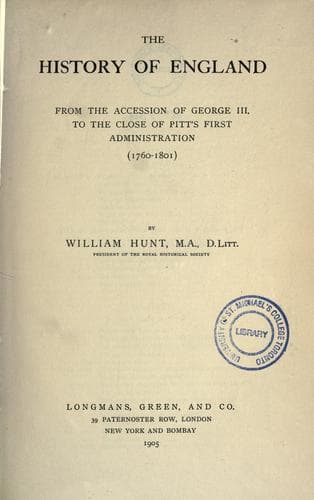
The history of England, from the accession of George III. to the close of Pitt's first administration, 1760-1801 — John Shaqi
The history of England, from the accession of George III. to the close of Pitt's first administration, 1760-1801Hunt, William
History
The history of England, from the accession of George III. to the close of Pitt's first administration, 1760-1801
Hunt, William
Great Britain -- History -- George III, 1760-1820
Since 1757 the strife of the whig factions had been stilled by
coalition. At the king's accession the administration was strong. It
owed its strength to the co-operation of the Duke of Newcastle, the
first lord of the treasury, and Pitt, secretary of state.[10] Newcastle,
the most prominent figure among the great whig nobles, derived his power
from influence; he had an unrivalled experience in party management and
as a dispenser of patronage, and though personally above accepting a
bribe of any kind, he was an adept at corrupt practices. He would have
been incapable of conducting the war, for he was ignorant, timid, and
vacillating, but he knew how to gain the support of parliament and how
to find the supplies which the war demanded. Pitt was strong in the
popular favour which he had gained by his management of the war; he was
supremely fitted to guide the country in time of war, but he was too
haughty and imperious to be successful in the management of a party. He
did not care to concern himself about applications for bishoprics,
excisorships, titles, and pensions, or the purchase of seats in
parliament. All such work was done by Newcastle. For his attack on the
whig party George needed a scheme and a man--some one to act for him in
matters in which as king he could not appear personally to interfere.
The man was ready to his hand, his friend and teacher, Bute. His scheme
of attack was to create a division between Newcastle and Pitt, to make
peace with France, and force Pitt to leave the ministry, Pitt's
resignation would weaken the whigs, and the king would be in a position
to give office to Bute and any other ministers he might choose.
Newcastle and Pitt were not really in accord, for not only was Newcastle
jealous of Pitt, but he was anxious to bring the war to an end while
Pitt wished to continue it. George therefore started on his work of
sowing dissension between them with something in his favour. He disliked
Pitt's war policy. He and Bute desired peace, no doubt for its own sake,
as well as because it would forward their plan, for when the war ended
the great war minister would no longer be necessary to the whigs.
Public-domain text, read in full here on John Shaqi.
Reviews
Reviews
No reviews yet
Be the first to share your thoughts on this work.
Join the Discussion
Join the discussion
Sign in to leave a comment or review.
Sign InorCreate an account