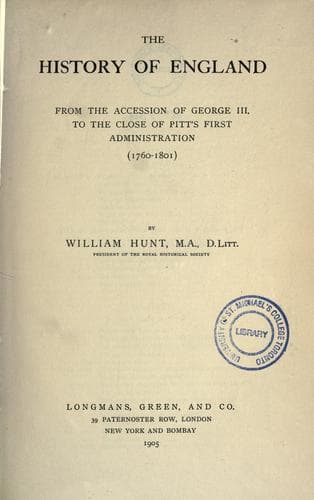
The history of England, from the accession of George III. to the close of Pitt's first administration, 1760-1801 — John Shaqi
The history of England, from the accession of George III. to the close of Pitt's first administration, 1760-1801Hunt, William
History
The history of England, from the accession of George III. to the close of Pitt's first administration, 1760-1801
Hunt, William
Great Britain -- History -- George III, 1760-1820
development of an inner cabinet, and such a body is understood to have
existed for many years during which cabinets have been of a size
undreamt of by ministers of George III.
The solidarity of the cabinet is now secured by the peculiar functions
and powers of a prime minister.[9] It was not so at the accession of
George III. That there should be an avowed prime minister possessing the
chief weight in the council and the principal place in the confidence of
the king is a doctrine which was not established until the first
administration of the younger Pitt; and though the title of prime
minister had come into use by 1760, it was still regarded as invidious
by constitutional purists. According to George's system he was himself
to be the only element of coherence in a ministry; it was to be formed
by the prime minister in accordance with his instructions, and each
member of it was to be guided by his will. The factious spirit of the
whigs, the extent to which they monopolised power, and the humiliating
position to which they had reduced the crown, afford a measure of
defence for his scheme of government. Yet it was in itself
unconstitutional, for it would have made the ministers who were
responsible to parliament mere agents of the king who was not personally
responsible for his public acts. And it was not, nor indeed could it be,
carried out except by adopting means which were unconstitutional and
disastrous. It necessarily made the king the head of a party. He needed
votes in parliament, and he obtained them, as the whig leaders had done,
by discreditable means. If his ministers did not please him he sought
support from the members of his party, "the king's friends," as they
were called; and so there arose an influence behind the throne distinct
from and often opposed to that of his responsible advisers.
[Sidenote: _THE KING'S SCHEME._]
Public-domain text, read in full here on John Shaqi.
Reviews
Reviews
No reviews yet
Be the first to share your thoughts on this work.
Join the Discussion
Join the discussion
Sign in to leave a comment or review.
Sign InorCreate an account