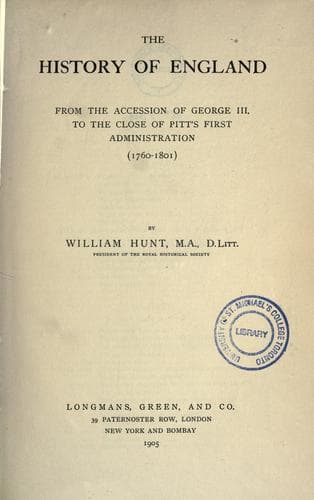
The history of England, from the accession of George III. to the close of Pitt's first administration, 1760-1801Hunt, William
History
The history of England, from the accession of George III. to the close of Pitt's first administration, 1760-1801
Hunt, William
Great Britain -- History -- George III, 1760-1820
Before the king and Bute opened their campaign they insured support in
parliament. Early in 1761 preparations were made for the general
election. The court spread the idea that it was for purity of election;
it was known that Newcastle's hands were tied, and it was expected that
no money would be issued from the treasury. Nothing was less true.
Corruption was rampant and the treasury issued large sums. George
personally named candidates for boroughs belonging to the crown, to
which the ministry had hitherto appointed, and otherwise took an active
share in the arrangements. For the most part he worked through Bute, to
whom Newcastle was forced to submit his lists of candidates that he
might compare them with his own and decide who should be brought in.
This was galling to the old minister, but he had already done much to
forward the whig interest in the coming election, and flattered himself
that "they [the court] had left matters too late for them to do any
mischief".[26] In former elections the whigs used the resources of the
crown to secure power for themselves; in this election the crown itself
used its own means of corrupt influence. Private men followed its
example. A new class of candidates appeared, men without party connexion
or local interest, who had lately become rich, West India merchants,
"nabobs" gorged with the spoils of the East, shareholders of the East
India Company, admirals and others who had reaped a splendid harvest
from the destruction of the commerce and shipping of France. The
competition for seats was extraordinary; at Andover there were nine
candidates. Constituencies which had long obeyed the orders of great
landlords were no longer to be reckoned upon. No political question was
exciting public interest, and the borough elections were decided rather
by money than by measures. Bribery was carried to a preposterous height,
and the new-rich bought seats as openly as they bought their horses. The
borough of Sudbury went so far as to advertise itself for sale. Those
who without political aims or connexions forced themselves into
parliament by their wealth were peculiarly open to court influence.
Newcastle's belief that the elections would secure his position was
ill-founded; many members on whom he relied were ready to desert him at
the bidding of the court. By the beginning of March, before the
elections were over, the king and Bute were sure of the support they
desired.
Public-domain text, read in full here on John Shaqi.
Reviews
Reviews
No reviews yet
Be the first to share your thoughts on this work.
Join the Discussion
Join the discussion
Sign in to leave a comment or review.
Sign InorCreate an account