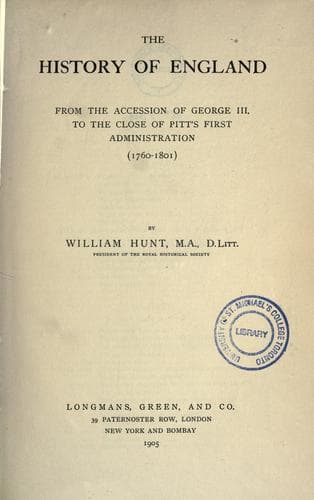
The history of England, from the accession of George III. to the close of Pitt's first administration, 1760-1801Hunt, William
History
The history of England, from the accession of George III. to the close of Pitt's first administration, 1760-1801
Hunt, William
Great Britain -- History -- George III, 1760-1820
Bute was in a position which enabled him to take office and to begin to
carry out the designs cherished by his master and himself, to bring the
war to an end and to encourage the jealousy of Pitt's colleagues to such
an extent that they would force him to leave them. He could be dispensed
with as soon as peace was made, and without him the whig ranks could
easily be broken up, for Newcastle could be crushed at any time. With
Bute as an ally Pitt dominated over his fellow-ministers, who bore his
yoke with rebellious feelings. If Bute came over to their side they
could make a stand against him. Viri's secret negotiations on Bute's
behalf gave them a chance not to be neglected. Newcastle, Hardwicke, and
the Duke of Devonshire took counsel together, and Newcastle went to the
king with a proposal that Bute should accept office. To this George, of
course, readily assented. Pitt knew nothing of all this until the matter
was settled.[27] On March 12 Holdernesse was dismissed. It was not a
creditable business; four months before he had signified his readiness
to make room for Bute,[28] and he received a present pension of L4,000 a
year and the reversion of the wardenship of the Cinque Ports, which was
at least equally valuable, as a reward for his complaisance. He was
succeeded by Bute as secretary of state on the 25th.
At the same time Legge, the chancellor of the exchequer, who had refused
to accede to Bute's wishes with regard to two elections, and was much
disliked by the king,[29] was dismissed, and was succeeded by Lord
Barrington, an honest man, with no strong political convictions, who was
always ready to carry out the king's plans. Barrington was succeeded as
secretary-at-war by Charles Townshend, a brilliant wit and orator, "the
delight and ornament" of the house of commons,[30] a reckless and
unstable politician, who was destined to bring evil on his country. A
month earlier, one of Bute's adherents, George Grenville, the treasurer
of the navy, a brother of Earl Temple, lord privy seal, and a
brother-in-law of Pitt, was rewarded by a seat in the cabinet. He had
considerable ability, great aptitude for business, and a thorough
knowledge of parliamentary affairs, was a statesman of unsullied purity,
public-spirited, hard-working and ambitious;[31] he was deficient in
tact, had no generosity of mind, and was harsh, formal, and impatient of
opposition. Newcastle's perfidy increased the ill-feeling between him
and Pitt, against whom the new alliance was avowedly directed,[32] for
at the time that Newcastle sold himself to Bute in order to gain his
support, Pitt was becoming aware that the king was probably about to
oppose his policy with respect to the war. Newcastle was delighted with
the success of his trick, but he soon found that Bute slighted him, and
that his power was going from him, for he was no longer allowed to
control the patronage of the crown.[33] By treating him in this way the
king and Bute kept him subservient.
Public-domain text, read in full here on John Shaqi.
Reviews
Reviews
No reviews yet
Be the first to share your thoughts on this work.
Join the Discussion
Join the discussion
Sign in to leave a comment or review.
Sign InorCreate an account