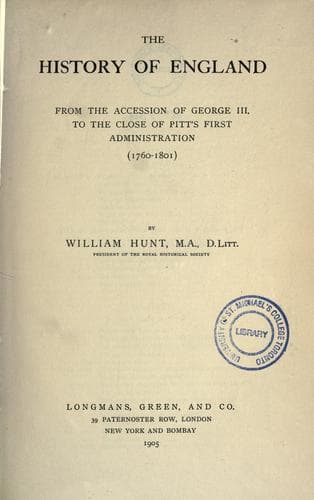
The history of England, from the accession of George III. to the close of Pitt's first administration, 1760-1801Hunt, William
History
The history of England, from the accession of George III. to the close of Pitt's first administration, 1760-1801
Hunt, William
Great Britain -- History -- George III, 1760-1820
A few days later Edmund Burke made his first speech in parliament,
recommending the house to receive a petition from the colonies, and was
at once recognised as a new power. He was an Irishman, and was already
known as a writer. He became Rockingham's secretary in 1765, and a seat
was provided for him. Unsurpassed in his mastery of English prose, he
exhibits to the full the splendour of the English language in his
speeches and pamphlets. Nor is his thought unworthy of the gorgeous
attire with which it is invested. His power and constant habit of
discerning and expounding the principles which were involved in
questions of the moment, give him a supreme place as a teacher of
political wisdom. In character he was pure, generous, and
tender-hearted. His fervid imagination extended the area of his
sympathies, and sometimes prejudiced his opinions. As a speaker he was
eloquent, and now and again carried his audience completely with him,
but he never caught the tone of the house of commons; his longer
speeches were too much of the nature of exhaustive treatises to be
acceptable to its members; he had little tact, an impatient temper, and
often spoke with execrable taste. The chief article in his political
creed was his belief in the excellence of the constitution. He was an
ardent reformer of abuses, but with the constitution itself he would
have no meddling. Unlike Pitt, he saw that the only effectual check to
corrupt influence was to be found in government by a party united for
the promotion of national interests upon some common principle. Such a
party might, he believed, be based on the whig families, if only they
would keep themselves free from court intrigue and selfish jealousies.
He was a whig of a different type from Newcastle and Bedford; he built
his hopes on the Rockinghams and inspired their policy. That he never
sat in a cabinet was chiefly because in those days such a distinction
was confined to men of higher birth.
[Sidenote: _REPEAL OF THE STAMP ACT._]
Public-domain text, read in full here on John Shaqi.
Reviews
Reviews
No reviews yet
Be the first to share your thoughts on this work.
Elsewhere in the archive
Join the Discussion
Join the discussion
Sign in to leave a comment or review.
Sign InorCreate an account