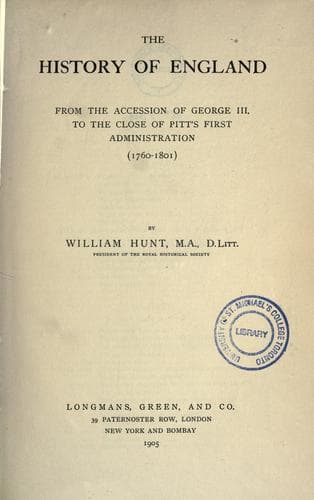
The history of England, from the accession of George III. to the close of Pitt's first administration, 1760-1801Hunt, William
History
The history of England, from the accession of George III. to the close of Pitt's first administration, 1760-1801
Hunt, William
Great Britain -- History -- George III, 1760-1820
Decided action with regard to America was a pressing necessity. The
measures of retaliation adopted by the colonists were depressing trade
at home. Petitions against the stamp act were presented from the
merchants of London, Liverpool, Glasgow, and other towns, setting forth
the loss inflicted on manufacturers and their work-people by the
stoppage of the American trade, and the difficulties arising from the
non-payment of debts due from America, which amounted to L4,000,000. The
ministers resolved on the repeal of the act, and on a bill declaring the
right of parliament to legislate for the colonies on all matters
whatsoever. Some of the king's household having voted against the
government, Rockingham went to the king to remonstrate with him. George
told him that he was for repeal, and that Rockingham might say so. Two
days later the ministers heard that Lord Strange, one of the court
party, was saying that the king was against repeal, and wished it to be
known. This made a great stir, and the "ministerial lives were thought
not worth three days' purchase". Rockingham went to the king for an
explanation. George acknowledged that he had told him that he was for
repeal, but said that they had been speaking only of the choice between
the repeal and the enforcement of the act, that of the two he was for
repeal, but that he desired that the act should be modified and not
repealed. The ministers had therefore "to carry on a great public
measure against the king's declared sentiments, and with a great number
of his servants acting against them".[73] Nevertheless the bill for the
repeal of the act was carried in the commons on March 11 by 275 votes to
167, and a week later in the lords by 105 to 71. It was a signal
victory; but, apart from the interests of commerce, it was due rather to
Pitt than to the government. The declaratory bill also passed; its chief
opponents being Pitt and, in the upper house, Lord Camden, who on this
question, as well as on that of repeal, talked much trash about a
fundamental law of nature and the limits of the power of parliament,
more in place in the mouth of an American demagogue than of an English
judge. An address was also carried recommending that the colonial
governors should be instructed to require compensation to be made to
those who had suffered during the late disturbances.
Public-domain text, read in full here on John Shaqi.
Reviews
Reviews
No reviews yet
Be the first to share your thoughts on this work.
Elsewhere in the archive
Join the Discussion
Join the discussion
Sign in to leave a comment or review.
Sign InorCreate an account