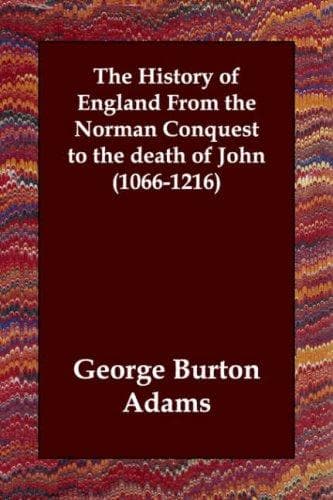
The History of England from the Norman Conquest to the Death of John (1066-1216)Adams, George Burton
History
The History of England from the Norman Conquest to the Death of John (1066-1216)
Adams, George Burton
Great Britain -- History -- Medieval period, 1066-1485
But certainly not in all cases did things go so easily for the English.
Two bits of evidence, one in the Saxon Chronicle, that men bought their
lands of the king, and one in Domesday Book, a statement of the
condition of a piece of land "at the time when the English redeemed their
lands," lead us to infer that William demanded of the English that they
obtain from him in form a confirmation of their possessions for which
they were obliged to pay a price. No statement is made of the reasons by
which this demand was justified, but the temptation to regard it as an
application of the principle of the feudal relief is almost irresistible;
of the relief paid on the succession of a new lord, instead of the
ordinary relief paid on the recognition of the heir to the fief. If the
evidence were greater that this was a common practice in feudalism rather
than an occasional one, as it seems only to have been, it would give us
the simplest and most natural explanation of this act of William's. To
consider that he regarded all the land of the kingdom as rightly
confiscate, which has been suggested as an explanation, because of a
resistance which in many cases never occurred, and in most had not at the
time when this regulation must have been made, is a forced and unnatural
theory, and not in harmony with William's usual methods. To suppose that
he regarded this as an exceptional case, in which a relief on a change of
lords could be collected, is a less violent supposition. Possibly it was
an application more general than ordinary of the practice which was usual
throughout the medieval world of obtaining at a price, from a new king,
confirmations of the important grants of his predecessors. But any
explanation of the ground of right on which the king demanded this
general redemption of lands must remain from lack of evidence a mere
conjecture. The fact itself seems beyond question, and is an indication
of no little value of the views and intentions of the new king. The
kingdom was his; all the land must be held of him and with his formal
consent, but no uncalled-for disturbance of possession was to occur.
Public-domain text, read in full here on John Shaqi.
Reviews
Reviews
No reviews yet
Be the first to share your thoughts on this work.
Join the Discussion
Join the discussion
Sign in to leave a comment or review.
Sign InorCreate an account