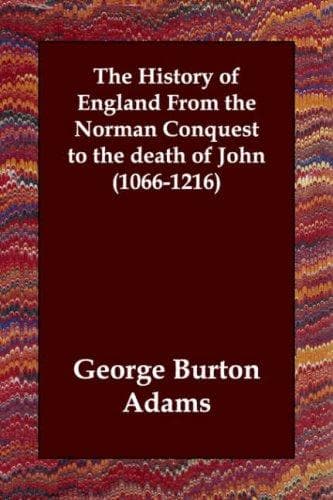
The History of England from the Norman Conquest to the Death of John (1066-1216)Adams, George Burton
History
The History of England from the Norman Conquest to the Death of John (1066-1216)
Adams, George Burton
Great Britain -- History -- Medieval period, 1066-1485
city, intimately concerned in such a revolution, would be most
anxious,--the establishment of law and the security of property. The king
pledges himself to introduce no foreign law and to make no arbitrary
confiscations of property. To win the steady adhesion of that most
influential body of men who were always at hand to bring the pressure of
their public opinion to bear upon the leaders of the state, the
inhabitants of London, this measure was as wise as was the building of
the Tower for security against the sudden tumults so frequent in the
medieval city, or even more dangerous insurrections.
At the same time strict regulations were made for the repression of
disorders in the army. The leaders were exhorted to justice and to avoid
any oppression of the conquered; the soldiers were forbidden all acts of
violence, and the favourite vices of armies were prohibited,--too much
drinking, we are told, lest it should lead to bloodshed. Judges were
appointed to deal with the offences of the soldiers; the Norman members
of the force were allowed no special privileges; and the control of law
over the army, says the king's chaplain, proudly, was made as strict as
the control of the army over the subject race. Attention was given also
to the fiscal system of the country, to the punishment of criminals, and
to the protection of commerce. Most of this we may well believe, though
some details of fact as well as of motive may be too highly coloured, for
our knowledge of William's attitude towards matters of this kind is not
dependent on the words of any panegyrist.
While William waited at Barking, other English lords in addition to those
who had already acknowledged him came in and made submission. The Norman
authorities say that the earls Edwin and Morcar were the chief of these,
and if not earlier, they must have submitted then. Two men, Siward and
Eldred, are said to have been relatives of the last Saxon king, but in
what way we do not know. Copsi, who had ruled Northumberland for a time
under Tostig, the brother of Harold, impressed the Norman writers with
his importance, and a Thurkill is also mentioned by name, while "many
other nobles" are classed together without special mention. Another great
name which should probably be added to this list is that of Waltheof,
Earl of Northampton and Huntingdon, of distinguished descent and destined
later to an unhappy fate. All of these the king received most kindly. He
accepted their oaths, restored to them all their possessions, and held
them in great honour.
Public-domain text, read in full here on John Shaqi.
Reviews
Reviews
No reviews yet
Be the first to share your thoughts on this work.
Join the Discussion
Join the discussion
Sign in to leave a comment or review.
Sign InorCreate an account