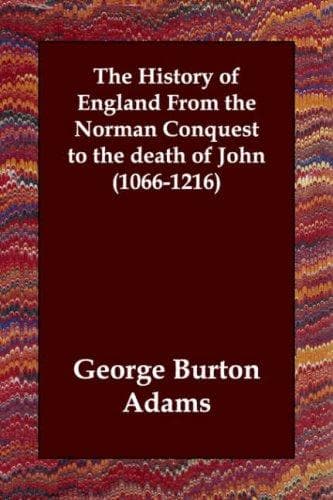
The History of England from the Norman Conquest to the Death of John (1066-1216) — John Shaqi
The History of England from the Norman Conquest to the Death of John (1066-1216)Adams, George Burton
History
The History of England from the Norman Conquest to the Death of John (1066-1216)
Adams, George Burton
Great Britain -- History -- Medieval period, 1066-1485
When the hostile army drew near to the town, the courage of some of the
leading men failed, and they went out to seek terms of peace. They
promised to do whatever was commanded, and they gave hostages, but on
their return they found their negotiations disavowed and the city
determined to stand a siege. This lasted only eighteen days. Some decided
advantage which the Normans gained--the undermining of the walls seems
to be implied--induced the city to try again for terms. The clergy,
with their sacred books and relics, accompanied the deputation, which
obtained from the king better promises than had been hoped for. For some
reason William departed from his usual custom of severity to those who
resisted. He overlooked their evil conduct, ordered no confiscations, and
even stationed guards in the gates to keep out the soldiers who would
have helped themselves to the property of the citizens with some
violence. But as usual he selected a site for a castle within the walls,
and left a force of chosen knights under faithful command, to complete
the fortification and to form the garrison. Harold's mother, Gytha, left
the city before its surrender, and finally found a refuge in Saint Omer,
in Flanders. Harold's sons also, if they were in Exeter, made their
escape before its fall.
After subduing Exeter, William marched with his army into Cornwall, and
put down without difficulty whatever resistance he found there. The
confiscation of forfeited estates was no doubt one object of his march
through the land, and the greater part of these were bestowed upon his
own half brother, Robert, Count of Mortain, the beginning of what grew
ultimately into the great earldom of Cornwall. In all, the grants which
were made to Robert have been estimated at 797 manors, the largest made
to any one as the result of the Conquest. Of these, 248 manors were in
Cornwall, practically the whole shire; 75 in Dorset, and 49 in
Devonshire. This was almost a principality in itself, and is alone nearly
enough to disprove the policy attributed to William of scattering about
the country the great estates which he granted. So powerful a possession
was the earldom which was founded upon this grant that after a time the
policy which had been followed in Normandy, in regard to the great
counties, seemed the only wise one in this case also, and it was not
allowed to pass out of the immediate family of the king until in the
fourteenth century it was made into a provision for the king's eldest
son, as it has ever since remained. These things done, William disbanded
his army and returned to spend Easter at Winchester.
Public-domain text, read in full here on John Shaqi.
Reviews
Reviews
No reviews yet
Be the first to share your thoughts on this work.
Join the Discussion
Join the discussion
Sign in to leave a comment or review.
Sign InorCreate an account