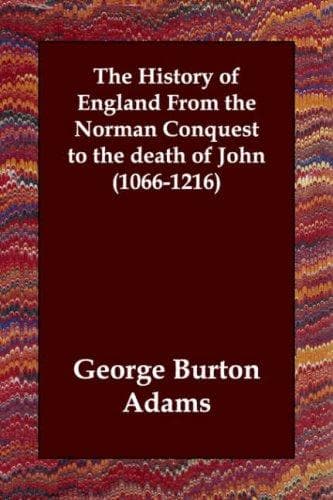
The History of England from the Norman Conquest to the Death of John (1066-1216) — John Shaqi
The History of England from the Norman Conquest to the Death of John (1066-1216)Adams, George Burton
History
The History of England from the Norman Conquest to the Death of John (1066-1216)
Adams, George Burton
Great Britain -- History -- Medieval period, 1066-1485
Once more for a moment the land seemed to be at peace, and William was
justified in looking upon himself as now no longer merely the leader of a
military adventure, seeking to conquer a foreign state, but as firmly
established in a land where he had made a new home for his house. He
could send for his wife; his children should be born here. It should be
the native land of future generations for his family. Matilda came soon
after Easter, with a distinguished train of ladies as well as lords, and
with her Guy, Bishop of Amiens, who, Orderic tells us, had already
written his poem on the war of William and Harold. At Whitsuntide, in
Westminster, Matilda was crowned queen by Archbishop Aldred. Later in the
summer Henry, the future King Henry I, was born, and the new royal family
had completely identified itself with the new kingdom.
But a great task still lay before the king, the greatest perhaps that he
had yet undertaken. The north was his only in name. Scarcely had any
English king up to this time exercised there the sort of authority to
which William was accustomed, and which he was determined to exercise
everywhere. The question of the hour was, whether he could establish his
authority there by degrees, as he seemed to be trying to do, or only
after a sharp conflict. The answer to this question was known very soon
after the coronation of Matilda. What seemed to the Normans a great
conspiracy of the north and west was forming. The Welsh and English
nobles were making common cause; the clergy and the common people joined
their prayers; York was noted as especially enthusiastic in the cause,
and many there took to living in tents as a kind of training for the
conflict which was coming. The Normans understood at the time that there
were two reasons for this determination to resist by force any further
extension of William's rule. One was, the personal dissatisfaction of
Earl Edwin. He had been given by William some undefined authority, and
promoted above his brother, and he had even been promised a daughter of
the king's as his wife. Clearly it had seemed at one time very necessary
to conciliate him. But either that necessity had passed away, or William
was reluctant to fulfil his promise; and Edwin, discontented with the
delay, was ready to lead what was for him at least, after he had accepted
so much from William, a rebellion. He was the natural leader of such an
attempt; his family history made him that. Personal popularity and his
wide connexions added to his strength, and if he had had in himself the
gifts of leadership, it would not have been even then too late to dispute
the possession of England on even terms. The second reason given us is
one to which we must attach much greater force than to the personal
influence of Edwin. He in all probability merely embraced an opportunity.
The other was the really moving cause. This is said to have been the
discontent of the English and Welsh nobles under the Norman oppression,
Public-domain text, read in full here on John Shaqi.
Reviews
Reviews
No reviews yet
Be the first to share your thoughts on this work.
Join the Discussion
Join the discussion
Sign in to leave a comment or review.
Sign InorCreate an account