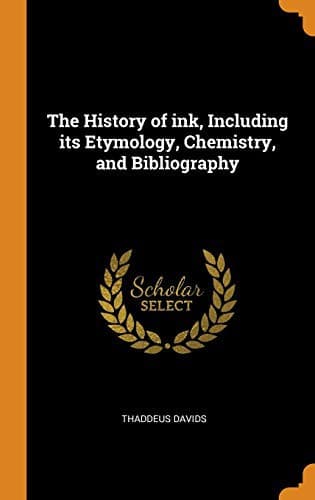
The History of Ink, Including Its Etymology, Chemistry, and Bibliography — John Shaqi
The History of Ink, Including Its Etymology, Chemistry, and BibliographyDavids, Thaddeus
History
The History of Ink, Including Its Etymology, Chemistry, and Bibliography
Davids, Thaddeus
Ink
COMMON BLACK WRITING-INK is the tannate of the sesquoxyd of iron mixed
with a smaller quantity of the gallate of the sesquoxyd of iron. When in
the liquid form, it is generally the tannate and gallate of the
protoxyd; but after being long kept, (or put on the paper and drying
there,) it absorbs more oxygen from the atmosphere; and thus the saline
compounds become the per-tannate and per-gallate, which are blacker than
the tannate and gallate of the protoxyd. It is thus and therefore that
good modern ink is known by the simple test-quality of darkening by age.
On the other hand, when writing becomes yellow, pale or indistinct by
age, it is from the decay of the imperfectly combined vegetable
astringent,—the marks on the paper or parchment being then little more
than the stain of the per-oxyd (that is the sesquoxyd) of iron. If the
written surface be then carefully washed or even moistened with the
infusion of nut-galls, it will be rendered blacker, and if before
indistinct will become legible. This may sometimes be better
accomplished by first applying a weak solution of oxalic acid or very
dilute muriatic (hydro-chloric) acid, and then delicately laying on the
infusion of galls.
When the writing paper has been made of inferior rags, bleached with
chlorine, the best ink used upon it is liable to become discolored.
Nut-gulls or gall-nuts (_Gallæ-tinctoriæ_) are excrescences growing upon
the leaves or twigs of oak trees, (especially the _Quercus infectoria_,)
caused by the puncture of an insect (the _Cynips gallæ-tinctoriæ_) which
deposits its eggs in the perforations thus made. The _Quercus
infectoria_ is most abundant in Persia, Mesopotamia, Syria and Asia
Minor, from which countries the galls are brought in large quantities to
the manufactories of Europe and America. The best are called “ALEPPO
galls,” from the name of the Syrian city which is the chief original
market for them. Those from Smyrna are also highly esteemed.
They contain the vegetable astringent principle called _tannin_ in
greater abundance than any other known substance. This is chemically
resolved into the acids known as the tannic and gallic. All the woods
and barks employed in the manufacture of leather by the tanning of hides
contain this astringent matter in various degrees. The oak and the
hemlock, for instance, are in extensive and familiar use for this
purpose in the United States. The blackness of ink, as has been already
indicated, is derived from the combination of these two acids with
oxydized iron in saline compounds which are insoluble in water, and are
therefore precipitated or deposited at the bottom of the fluid, unless
held mechanically suspended in it, by gum, sugar or some similar
substance which gives the quality of viscidity to its solutions.
Public-domain text, read in full here on John Shaqi.
Reviews
Reviews
No reviews yet
Be the first to share your thoughts on this work.
Join the Discussion
Join the discussion
Sign in to leave a comment or review.
Sign InorCreate an account