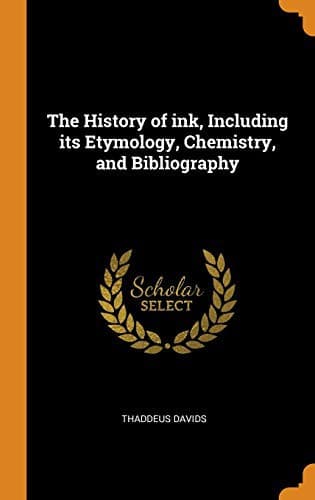
The History of Ink, Including Its Etymology, Chemistry, and Bibliography — John Shaqi
The History of Ink, Including Its Etymology, Chemistry, and BibliographyDavids, Thaddeus
History
The History of Ink, Including Its Etymology, Chemistry, and Bibliography
Davids, Thaddeus
Ink
MODERN INK, on the contrary, leaves its marks upon paper, parchment,
&c., by penetrating the material to such a depth that it cannot be
erased (mechanically) without the removal or destruction of the surface
which it has _tinged_. Chemical agency, as of various acids, chlorine
and its compounds, is generally employed, therefore, to discharge the
color from modern writing-ink-marks. CARBON, in all its common forms,
(charcoal, bituminous coal, anthracite, jet, plumbago, lignite,
ivory-black, lamp-black and soot,) is wholly unalterable in color by any
of these chemical means.
PRINTING INK (which is composed of carbon suspended in a drying oil) is,
in essential characteristics, identical with the writing-inks of the
ancient Romans and Greeks. It is impressed upon the surface of paper,
(that which is _unsized_ or bibulous being commonly preferred,) and is
retained unchanged by the action of moisture, on account of the
insolubility of the carbon and the repulsion between oil and water.
These two forms of ink are therefore the exact opposites of each other,
in the qualities on which their use and permanence depend. The most
important peculiarity of the modern writing-ink, as contrasted with the
ancient, naturally suggested the two names which it bore in the Latin
and Greek of the middle ages, or (to speak more definitely,) the time of
its invention and first employment. It was a _Tincta_, a DYE, or STAIN,
which _tinged_ and _tinctured_ the material on which it was placed,
entering among its fibres as coloring fluids do into cloth in the
ordinary processes of manufacture. It penetrated the substance of the
paper (as caustics or powerful chemical solvents and corrosives act on
the organic fibre): it _bit in_, or _burned in_,—and was therefore well
named ENCAUSTON and _Incaustum_.
CHEMISTRY or COMPOSITION of INK.
We do not propose to furnish recipes, prescriptions, directions or
instructions for the manufacture of this article. No mere statement in
words can enable any one to arrive at perfection, or excellence, or
practical success in the production of this article, or any articles
whatsoever. A skill and carefulness, which can be acquired only by long
and laborious experience, are indispensable to the management of the
various processes. Time is an essential element of success in this
peculiar art; and that makes absolutely requisite also, two other
conditions,—_patience_ and _capital_. We shall therefore be brief on
this point,—referring those who wish for minute details, to the
cyclopaedias, dictionaries of the arts and sciences, and the larger
works on practical chemistry. The following we venture to present as the
most correct account of this subject, derived from the latest scientific
and practical authorities.
The composition of ink varies according to its colors, and the purposes
to which it is to be applied.
Public-domain text, read in full here on John Shaqi.
Reviews
Reviews
No reviews yet
Be the first to share your thoughts on this work.
Join the Discussion
Join the discussion
Sign in to leave a comment or review.
Sign InorCreate an account