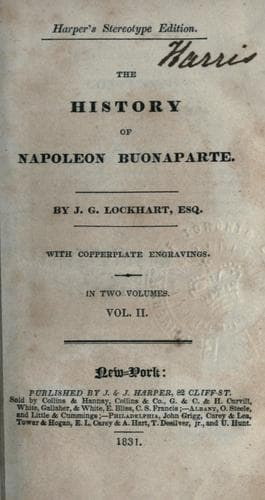
The History of Napoleon BuonaparteLockhart, J. G. (John Gibson)
History
The History of Napoleon Buonaparte
Lockhart, J. G. (John Gibson)
France -- Kings and rulers -- Biography; Napoleon I, Emperor of the French, 1769-1821
Meanwhile it was necessary that the government itself should assume some
permanent form, ere the time arrived for the re-assembly of the
legislative bodies. Their two committees met in one chamber with the
consuls, and the outline of a new constitution was laid before them by
Sieyes; who enjoyed the reputation of being the greatest of scientific
politicians. The Abbé, however, had soon perceived that Napoleon was to
be the real creator of whatever should be adopted; and, in the progress
of the ensuing consultations, submitted, step by step, to the laconic
Dictator, who accepted or discarded propositions, exactly as they
happened to coincide, or be at variance with, his own notions of his own
personal interest. He cared little in what manner the structure of the
future representative assemblies might be arranged; but there must be no
weakening of the executive power, which he was determined to vest
virtually in himself alone, and by means of which, he doubted not, it
would be easy to neutralise all other influences.
The metaphysical Abbé proposed a scheme by far too delicately
complicated for the tear and wear of human business and human passions.
The absurdity, even of the parts which Napoleon consented to adopt,
became apparent to all when the machine was set in motion. The two most
prominent and peculiar devices--namely, that of placing at the head of
the state a sort of mock sovereign, destitute of any effective power,
and capable at any time of being degraded by the vote of a single
legislative body, under the title of GRAND ELECTOR; and secondly, that
of committing the real executive power to two separate consuls, one for
war and one for peace, nominally the inferiors of the Elector, but in
influence necessarily quite above him, and almost as necessarily the
rivals and enemies of each other; these ingenious twins were strangled
in the birth by Napoleon's shrewd practical sense. "Who," said he,
"would accept an office, the only duties of which were to fatten like a
pig, on so many millions a year? And your two consuls--the one
surrounded with churchmen, lawyers, and civilians--the other with
soldiers and diplomatists--on what footing would be their intercourse?
the one demanding money and recruits, the other refusing the supplies? A
government, made up of such heterogeneous and discordant materials,
would be the shadow of a state." He added two words, which at once
decided the main question; "I, for one, would never be your Grand
Elector."
Public-domain text, read in full here on John Shaqi.
Reviews
Reviews
No reviews yet
Be the first to share your thoughts on this work.
Elsewhere in the archive
Join the Discussion
Join the discussion
Sign in to leave a comment or review.
Sign InorCreate an account