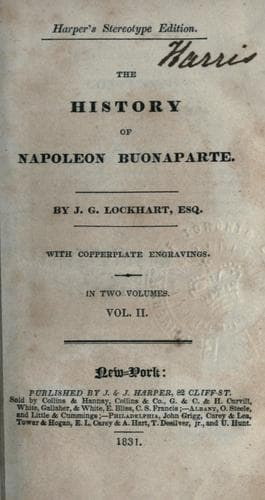
The History of Napoleon BuonaparteLockhart, J. G. (John Gibson)
History
The History of Napoleon Buonaparte
Lockhart, J. G. (John Gibson)
France -- Kings and rulers -- Biography; Napoleon I, Emperor of the French, 1769-1821
The plan of Buonaparte appears _now_ the simplest and most obvious that
could have been suggested; yet it was not without great difficulty that
he could obtain the approbation of the doctor, who had by this time
superseded the painter. "Your object," said he, "is to make the English
evacuate Toulon. Instead of attacking them in the town, which must
involve a long series of operations, endeavour to establish batteries so
as to sweep the harbour and roadstead. If you can do this--the English
ships must take their departure, and the English troops will certainly
not remain behind them." He pointed out a promontory nearly opposite the
town, by getting the command of which he was sure the desired effect
must be accomplished. "Gain _La Grasse_" said he, "and in two days
Toulon falls." His reasoning at length forced conviction, and he was
permitted to follow his own plan.
A month before nothing could have been more easy; but within that time
the enemy had perceived the importance of the promontory, which commands
the narrow passage between the port and the Mediterranean, and fortified
it so strongly, that it passed by the name of the Little Gibraltar. It
was necessary, therefore, to form extensive batteries in the rear of La
Grasse, before there could be a prospect of seizing it. Buonaparte
laboured hard all day, and slept every night in his cloak by the guns,
until his works approached perfection. He also formed a large battery
behind Malbosquet; but this he carefully concealed from the enemy. It
was covered by a plantation of olives, and he designed to distract their
attention by opening its fire for the first time when he should be about
to make his great effort against Little Gibraltar. But the
Representatives of the People had nearly spoiled everything. These
gentlemen, walking their rounds, discovered the battery behind the
olives, and inquiring how long it had been ready, were told for eight
days. Not guessing with what views so many guns had been kept so long
idle, they ordered an immediate cannonade. The English made a vigorous
sally, and spiked the guns before Buonaparte could reach the spot. On
his arrival at the eminence behind, he perceived a long deep ditch,
fringed with brambles and willows, which he thought might be turned to
advantage. He ordered a regiment of foot to creep along the ditch, which
they did without being discovered until they were close upon the enemy.
General O'Hara, the English commander, mistook them for some of his own
allies, and, rushing out to give them some direction, was wounded and
made prisoner. The English were dispirited when they lost their general;
they retreated, and the French were at liberty to set about the repair
of their battery. In this affair much blood was shed. Napoleon himself
received a bayonet-thrust in his thigh, and fell into the arms of
Muiron, who carried him off the field. Such was the commencement of
their brotherly friendship. His wound, however, did not prevent him from
Public-domain text, read in full here on John Shaqi.
Reviews
Reviews
No reviews yet
Be the first to share your thoughts on this work.
Join the Discussion
Join the discussion
Sign in to leave a comment or review.
Sign InorCreate an account