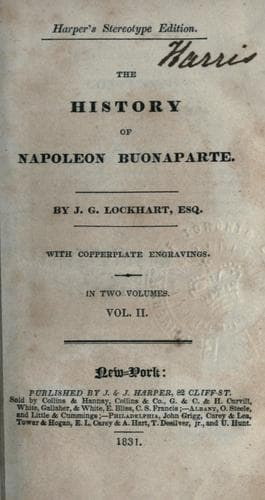
The History of Napoleon BuonaparteLockhart, J. G. (John Gibson)
History
The History of Napoleon Buonaparte
Lockhart, J. G. (John Gibson)
France -- Kings and rulers -- Biography; Napoleon I, Emperor of the French, 1769-1821
continuing his labours behind Little Gibraltar.
That fort had very nearly been seized, by a sort of accident, some time
before his preparations were completed; a casual insult excited a sudden
quarrel between the men in Buonaparte's trenches and the Spaniards in
Little Gibraltar. The French soldiers, without waiting for orders,
seized their arms, and rushed to the assault with fury. Napoleon coming
up, perceived that the moment was favourable, and persuaded Doppet to
support the troops with more regiments; but the doctor, marching at the
head of his column, was seized with a panic, on seeing a man killed by
his side, and ordered a retreat, before anything could be effected.
A few days after, this poltroon was in his turn superseded by a brave
veteran, General Dugommier, and Napoleon could at last count on having
his efforts backed. But, for the second time, the Representatives did
their best to ruin his undertaking. The siege had now lasted four
months, provisions were scarce in the camp, and these civilians, never
being able to comprehend what was meant by bestowing all this care on a
place so far below the city as Little Gibraltar, wrote to Paris that
they saw no chance of success, and hoped the government would agree with
them that the siege ought to be abandoned. Two days before this letter
reached Paris, Toulon had fallen, and the Representatives gave out that
the despatch was a forgery.
The moment had at last come when Buonaparte judged it right to make his
grand attempt. During the night of the 17th of December he threw 8000
bombs and shells into Little Gibraltar, and the works being thus
shattered, at daybreak Dugommier commanded the assault. The French,
headed by the brave Muiron, rushed with impetuous valour through the
embrasures, and put the whole garrison to the sword. The day was spent
in arranging the batteries, so as to command the shipping; and next
morning--so true had been Buonaparte's prophecy--when the French stood
to their posts, the English fleet was discovered to be already under
weigh.
Then followed a fearful scene. The English would not quit Toulon without
destroying the French ships and arsenals that had fallen into their
possession; nor could they refuse to carry with them the Antijacobin
inhabitants, who knew that their lives would be instantly sacrificed if
they should fall into the hands of the victorious Republicans, and who
now flocked to the beach to the number of 14,000, praying for the means
of escape. The burning of ships, the explosion of magazines, the roar of
artillery, and the cries of these fugitives, filled up many hours. At
last the men-of-war were followed by a flotilla bearing those miserable
exiles; the walls were abandoned; and Dugommier took possession of the
place.
Public-domain text, read in full here on John Shaqi.
Reviews
Reviews
No reviews yet
Be the first to share your thoughts on this work.
Join the Discussion
Join the discussion
Sign in to leave a comment or review.
Sign InorCreate an account