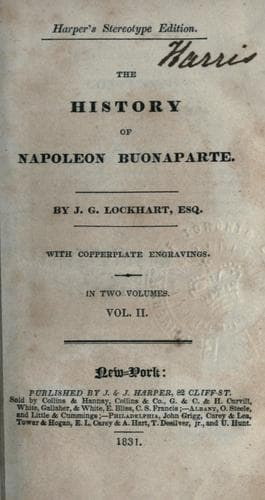
The History of Napoleon BuonaparteLockhart, J. G. (John Gibson)
History
The History of Napoleon Buonaparte
Lockhart, J. G. (John Gibson)
France -- Kings and rulers -- Biography; Napoleon I, Emperor of the French, 1769-1821
The Republicans found that all persons of condition, who had taken part
against them, had escaped; and their rage was to be contented with
meaner victims. A day or two having been suffered to pass in quiet, a
proclamation, apparently friendly, exhorted the workmen, who had been
employed on the batteries of the besieged town, to muster at
headquarters. One hundred and fifty poor men, who expected to be
employed again in repairing the same fortifications obeyed this
summons--were instantly marched into a field--and shot in cold blood;
not less than a thousand persons were massacred under circumstances
equally atrocious. Buonaparte himself repelled with indignation the
charge of having had a hand in this butchery. Even if he had, he was not
the chief in command, and durst not have disobeyed orders but at the
sacrifice of his own life. It is on all sides admitted that a family of
royalists, being shipwrecked on the coast near Toulon a few days after,
were rescued from the hands of the ferocious Republicans, solely by his
interference and address. Putting himself at the head of some of his
gunners, he obtained possession of the unhappy prisoners; quieted the
mob by assuring them that they should all be publicly executed the next
morning; and meanwhile sent them off during the night in artillery
waggons supposed to be conveying stores.
The recovery of Toulon was a service of the first importance to the
government. It suppressed all insurrectionary spirit in the south of
France; and placed a whole army at their disposal elsewhere. But he, to
whose genius the success was due, did not at first obtain the credit of
his important achievement at Paris. The Representatives of the People
never made their appearance on the eventful morning at Little Gibraltar,
until three hours after the troops were in possession of the best part
of the fortifications. Then, indeed, they were seen sword in hand in the
trenches, blustering and swaggering in safety. Yet these men did not
blush to represent themselves as having headed the assault, while, in
their account of the conflict, even the name of Buonaparte did not find
a place. The truth could not, however, be concealed effectually; and he
was appointed to survey and arrange the whole line of fortifications on
the Mediterranean coast of France.
It was during the siege of Toulon that Napoleon, while constructing a
battery under the enemy's fire, had occasion to prepare a despatch, and
called out for some one who could use a pen. A young sergeant, named
Junot, leapt out, and, leaning on the breastwork, wrote as he dictated.
As he finished, a shot struck the ground by his side, scattering dust in
abundance over him and everything near him. "Good," said the soldier,
laughing, "this time we shall spare our sand." The cool gaiety of this
pleased Buonaparte; he kept his eye on the man; and Junot came in the
sequel to be Marshal of France and Duke of Abrantes.
CHAPTER III
Public-domain text, read in full here on John Shaqi.
Reviews
Reviews
No reviews yet
Be the first to share your thoughts on this work.
Join the Discussion
Join the discussion
Sign in to leave a comment or review.
Sign InorCreate an account