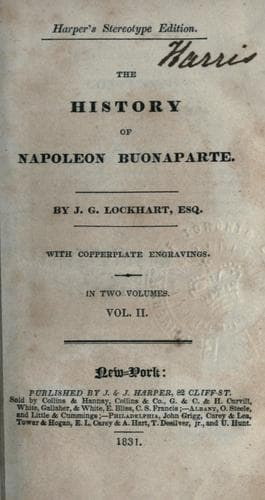
The History of Napoleon BuonaparteLockhart, J. G. (John Gibson)
History
The History of Napoleon Buonaparte
Lockhart, J. G. (John Gibson)
France -- Kings and rulers -- Biography; Napoleon I, Emperor of the French, 1769-1821
The next step was to prolong the period of his French Consulate. Chabot
de L'Allier, his creature, moved in the Tribunate that the Conservative
Senate should be requested to mark the national feelings of gratitude by
conferring some new honour on Napoleon. The Senate proposed accordingly
that he should be declared Consul for a second period of ten years, to
commence on the expiration of his present magistracy. He thanked them;
but said he could not accept of any such prolongation of his power
except from the suffrages of the people. To the people the matter was to
be referred; but the Second and Third Consuls, in preparing the edict of
the Senate for public inspection and ratification, were instructed by
their master-colleague to introduce an important change in its terms.
The question which they sent down was, "Shall Buonaparte be Chief Consul
for life?" No mention was made of _ten years_. Books were opened as on a
former occasion: the officers of government in the departments well knew
in what method to conduct the business, and the voice of the nation was
declared to be in favour of the decree. Some few hundreds of sturdy
republicans alone recorded their opposition; and Carnot, who headed
them, said he well knew he was signing his own sentence of exile. But
Napoleon was strong enough to dispense with any such severities; Carnot
remained in safety, but out of office, until, many years afterwards, his
services were tendered and accepted on the entrance of foreign invaders
into France. Buonaparte was proclaimed Consul for life on the 2nd of
August.
Shortly afterwards, in the committee occupied with the Code, Napoleon
entered upon a long disquisition in favour of the Roman law of adoption;
urging with intrepid logic, that an heir so chosen ought to be even
dearer than a son. The object of this harangue was not difficult of
detection. Napoleon had no longer any hope of having children by
Josephine; and meditated the adoption of one of his brother's sons as
his heir. In the course of the autumn a simple edict of the Conservative
Senate authorised him to appoint his successor in the consulate by a
testamentary deed. By this act (Aug. 4, 1802) a new dynasty was called
to the throne of France. The farce of opening books in the departments
was dispensed with. Henceforth the words "_Liberty, Equality,
Sovereignty of the People_," disappeared from the state papers and
official documents of the government--nor did the change attract much
notice. The nation had a master, and sate by, indifferent spectators;
while he, under whose sway life and property were considered safe,
disposed of political rights and privileges according to his
pleasure.[42]
Public-domain text, read in full here on John Shaqi.
Reviews
Reviews
No reviews yet
Be the first to share your thoughts on this work.
Elsewhere in the archive
Join the Discussion
Join the discussion
Sign in to leave a comment or review.
Sign InorCreate an account