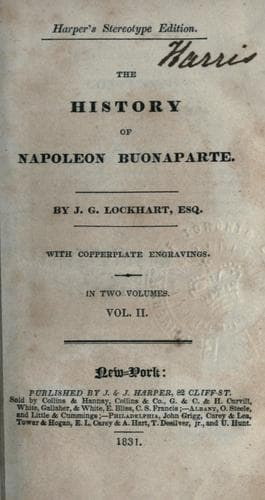
The History of Napoleon BuonaparteLockhart, J. G. (John Gibson)
History
The History of Napoleon Buonaparte
Lockhart, J. G. (John Gibson)
France -- Kings and rulers -- Biography; Napoleon I, Emperor of the French, 1769-1821
This year was distinguished by events of another order, and not likely
to be contemplated with indifference by the powers of Europe. After the
peace of Amiens was ratified, certain treaties which the Chief Consul
had concluded with Turkey, Spain, and Portugal, and hitherto kept
profoundly secret, were made known. The Porte, it now appeared, had
yielded to France all the privileges of commerce which that government
had ever conceded to the most favoured nations. Spain had agreed that
Parma, after the death of the reigning prince, should be added to the
dominions of France: and Portugal had actually ceded her province in
Guyana. In every quarter of the world the grasping ambition of
Buonaparte seemed to have found some prey.
Nearer him, in the meantime, he had been preparing to strike a blow at
the independence of Switzerland, and virtually unite that country also
to his empire. The contracting parties in the treaty of Luneville had
_guaranteed_ the independence of the Helvetic Republic, and the
unquestionable right of the Swiss to settle their government in what
form they pleased. There were two parties there as elsewhere--one who
desired the full re-establishment of the old federative
constitution--another who preferred the model of the French Republic
"one and indivisible." To the former party the small mountain cantons
adhered--the wealthier and aristocratic cantons to the latter. Their
disputes at last swelled into civil war--and the party who preferred the
old constitution, being headed by the gallant Aloys Reding, were
generally successful. Napoleon, who had fomented their quarrel, now,
unasked and unexpected, assumed to himself the character of arbiter
between the contending parties. He addressed a letter to the eighteen
cantons, in which these words occur:--"Your history shows that your
intestine wars cannot be terminated, except through the intervention of
France. I had, it is true, resolved not to intermeddle in your
affairs--but I cannot remain insensible to the distress of which I see
you the prey--I recall my resolution of neutrality--I _consent_ to be
the mediator in your differences." Rapp, adjutant-general, was the
bearer of this insolent manifesto. To cut short all discussion, Ney
entered Switzerland at the head of 40,000 troops. Resistance was
hopeless. Aloys Reding dismissed his brave followers, was arrested, and
imprisoned in the castle of Aarburg. The government was arranged
according to the good pleasure of Napoleon, who henceforth added to his
other titles that of "Grand Mediator of the Helvetic Republic."
Switzerland was, in effect, degraded into a province of France; and
became bound to maintain an army of 16,000 men, who were to be at the
disposal, whenever it should please him to require their aid, of the
Grand Mediator. England sent an envoy to remonstrate against this signal
and unprovoked rapacity: but the other powers suffered it to pass
without any formal opposition. The sufferings, however, of Aloys Reding
Public-domain text, read in full here on John Shaqi.
Reviews
Reviews
No reviews yet
Be the first to share your thoughts on this work.
Elsewhere in the archive
Join the Discussion
Join the discussion
Sign in to leave a comment or review.
Sign InorCreate an account