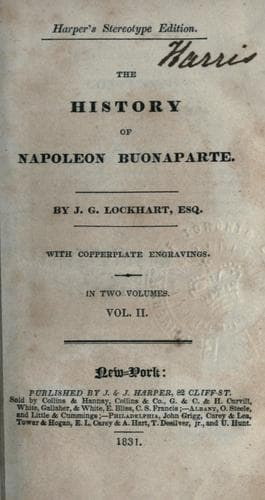
The History of Napoleon BuonaparteLockhart, J. G. (John Gibson)
History
The History of Napoleon Buonaparte
Lockhart, J. G. (John Gibson)
France -- Kings and rulers -- Biography; Napoleon I, Emperor of the French, 1769-1821
and his brave associates, and this audacious crushing-down of the old
spirit of Swiss freedom and independence, were heard of throughout all
Europe with deep indignation.
Feelings of the same kind were nourished everywhere by the results of an
expedition which Buonaparte sent, before the close of 1801, to St.
Domingo, for the purpose of reconquering that island to France. The
black and coloured population had risen, at the revolutionary period,
upon their white masters, and, after scenes of terrible slaughter and
devastation, emancipated themselves. The chief authority was, by
degrees, vested in Toussaint L'Ouverture, a negro, who, during the war,
displayed the ferocity of a barbarian, but after its conclusion, won the
applause and admiration of all men by the wisdom and humanity of his
administration. Conscious that, whenever peace should be restored in
Europe, France would make efforts to recover her richest colony,
Toussaint adopted measures likely to conciliate the exiled planters and
the government of the mother country. A constitution on the consular
model was established, Toussaint being its Buonaparte: the supremacy of
France was to be acknowledged to a certain extent; and the white
proprietors were to receive half the produce of the lands of which the
insurgents had taken possession. But Napoleon heard of all these
arrangements with displeasure and contempt. He fitted out a numerous
fleet, carrying an army full 20,000 strong, under the orders of General
Leclerc, the husband of his own favourite sister Pauline. It has often
been said, and without contradiction, that the soldiers sent on this
errand were chiefly from the army of the Rhine, whose good-will to the
Consul was to be doubted. Leclerc summoned Toussaint (Jan. 2, 1802) to
surrender, in a letter which conveyed expressions of much personal
respect from Buonaparte. The negro chief, justly apprehending
insincerity, stood out and defended himself gallantly for a brief space;
but stronghold after stronghold yielded to numbers and discipline; and
at length he too submitted, on condition that he should be permitted to
retire in safety to his plantation. Some obscure rumours of insurrection
were soon made the pretext for arresting him; and he, being put on board
ship, and sent to France, was shut up in a dungeon, where either the
midnight cord or dagger, or the wasting influence of confinement and
hopeless misery, ere long put an end to his life. His mysterious fate,
both before and after its consummation, excited great interest.[43] The
atrocious cruelty of the French soldiery, in their subjugation of St.
Domingo, equalled (it could not have surpassed) that of the barbarous
negroes whom they opposed; but was heard of with disgust and horror,
such as no excesses of mere savages could have excited. As if Heaven had
been moved by these bloody deeds of vengeance, disease broke out in the
camp; thousands, and among them Leclerc himself, died. For the time,
Public-domain text, read in full here on John Shaqi.
Reviews
Reviews
No reviews yet
Be the first to share your thoughts on this work.
Elsewhere in the archive
Join the Discussion
Join the discussion
Sign in to leave a comment or review.
Sign InorCreate an account