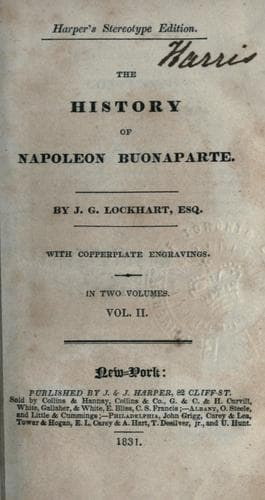
The History of Napoleon BuonaparteLockhart, J. G. (John Gibson)
History
The History of Napoleon Buonaparte
Lockhart, J. G. (John Gibson)
France -- Kings and rulers -- Biography; Napoleon I, Emperor of the French, 1769-1821
however, the French armament triumphed--and, in the exultation of
victory, the government at home had the extreme and seemingly
purposeless ungenerosity, to publish an edict banishing all of the negro
race from their European dominions.[44] But the yellow fever was already
rapidly consuming the French army in St. Domingo; and its feeble
remnant, under Rochambeau, having been at length expelled, in November,
1803, the independence of _Hayti_ was formally proclaimed on the 1st of
January, 1804.
The course of Napoleon's conduct, in and out of Europe, was calculated
to fill all independent neighbours with new or aggravated suspicion; and
in England, where public opinion possesses the largest means of making
itself heard, and consequently the greatest power, the prevalence of
such feelings became, from day to day, more marked. The British envoy's
reclamation against the oppression of Switzerland, was but one of many
drops, which were soon to cause the cup of bitterness to overflow. As in
most quarrels, there was something both of right and of wrong on either
side. When the English government remonstrated against any of those
daring invasions of the rights of independent nations, or crafty
enlargements, through diplomatic means, of the power of France, by which
this period of peace was distinguished, the Chief Consul could always
reply that the cabinet of St. James's, on their part, had not yet
fulfilled one article of the treaty of Amiens, by placing Malta in the
keeping of some power which had been neutral in the preceding war. The
rejoinder was obvious: to wit, that Napoleon was every day taking
measures wholly inconsistent with that balance of power which the treaty
of Amiens contemplated. It is not to be denied that he, in his
audaciously ambitious movements, had contrived to keep within the strict
terms of the treaty: and it can as little be disputed that the English
cabinet had _equity_ with them, although they violated the letter of the
law, in their retention of the inheritance of the worthless and
self-betrayed Knights of St. John.
Public-domain text, read in full here on John Shaqi.
Reviews
Reviews
No reviews yet
Be the first to share your thoughts on this work.
Elsewhere in the archive
Join the Discussion
Join the discussion
Sign in to leave a comment or review.
Sign InorCreate an account