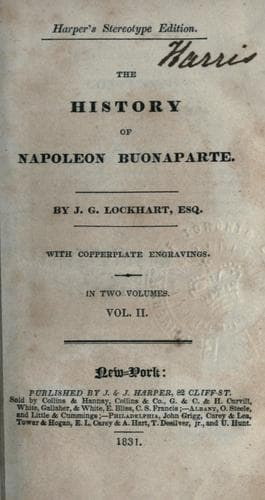
The History of Napoleon BuonaparteLockhart, J. G. (John Gibson)
History
The History of Napoleon Buonaparte
Lockhart, J. G. (John Gibson)
France -- Kings and rulers -- Biography; Napoleon I, Emperor of the French, 1769-1821
Even before Buonaparte proclaimed himself Consul for life, it appears
that, throughout a considerable part of the French army, strong symptoms
of jealousy had been excited by the rapidity of his advance to sovereign
power. After the monarchy of France was in effect re-established in him
and his dynasty, by the decrees of the 2nd and 4th of August, 1802, this
spirit of dissatisfaction showed itself much more openly; and ere long
it was generally believed that the republican party in the army looked
up to Moreau as their head, and awaited only some favourable opportunity
for rising in arms against Napoleon's tyranny. Moreau was known to have
treated both the Concordat and the Legion of Honour with undisguised
contempt; and Buonaparte's strictures on his conduct of the campaign of
1801 were not likely to have nourished feelings of personal goodwill in
the bosom of him whom all considered as second only to the Chief Consul
himself in military genius. It has already been intimated that the army
of the Rhine had been all along suspected of regarding Napoleon with
little favour. He had never been their general; neither they nor their
chiefs had partaken in the plunder of Italy, or in the glory of the
battles by which it was won. It was from their ranks that the unhappy
expedition under Leclerc had been chiefly furnished, and they considered
their employment in that unwholesome climate as dictated, more by the
Consul's doubts of their fidelity to himself, than his high appreciation
of their discipline and gallantry. How far Pichegru, while corresponding
with the Bourbons as head of the army of the Rhine, had intrigued among
his own soldiery, no evidence has as yet appeared. But after Pichegru's
banishment, Moreau possessed the chief sway over the minds of one great
division of the armed force of the Republic.
Carnot, meantime, and other genuine republicans in the legislative
bodies, had been occupied with the endeavour, since they could not
prevent Napoleon from sitting on the throne of France, to organise at
least something like a constitutional opposition (such as exists in the
Parliament of England) whereby the measures of his government might be,
to a certain extent, controlled and modified. The creation of the Legion
of Honour, the decree enabling Buonaparte to appoint his successor, and
other leading measures, had accordingly been carried through far less
triumphantly than could be agreeable to the self-love of the autocrat.
On the other hand, the return of so many emigrants--(a great part of
whom, not receiving back the property promised to them, were
disappointed and aggrieved anew)--could not fail to strengthen the
influence of the royalists in the private society of Paris; and by
degrees, as has often happened in the history of parties, the leaders of
the republicans and those of the Bourbonists came together, sinking for
the time the peculiar principles of either side, in the common feeling
of hatred to Napoleon.
Public-domain text, read in full here on John Shaqi.
Reviews
Reviews
No reviews yet
Be the first to share your thoughts on this work.
Elsewhere in the archive
Join the Discussion
Join the discussion
Sign in to leave a comment or review.
Sign InorCreate an account