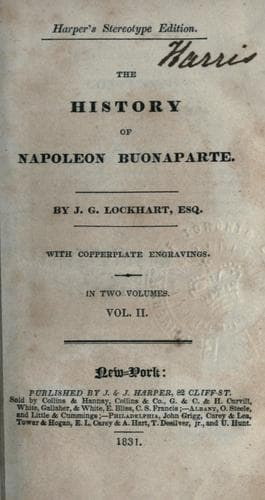
The History of Napoleon BuonaparteLockhart, J. G. (John Gibson)
History
The History of Napoleon Buonaparte
Lockhart, J. G. (John Gibson)
France -- Kings and rulers -- Biography; Napoleon I, Emperor of the French, 1769-1821
Moreau was innocent; by his side, on the day of trial, appeared men who
would have scorned to be so. Georges Cadoudal appeared in court with the
miniature of Louis XVI. suspended round his neck, and gloried in the
avowal of his resolution to make war personally on the usurper of the
throne. The presiding judge, Thuriot, had been one of those who
condemned the king to death. Georges punned on his name, and addressed
him as "Monsieur Tue-Roi."[50] When called up for sentence, the judge
missed the miniature, and asked him what he had done with it? "And you,"
answered the prisoner, "what have you done with the original?"--a retort
which nothing could prevent the audience from applauding. Georges and
eighteen more were condemned to death; and he, and eleven besides,
suffered the penalty with heroic firmness. Of the rest, among whom were
two sons of the noble house of Polignac, some were permitted to escape
on condition of perpetual banishment: others had their punishment
commuted to imprisonment.
With what indignation the death of the Duke d'Enghien had been heard of
throughout Europe, now began to appear. The Emperor of Russia and the
Kings of Sweden and Denmark put their courts into mourning, and made
severe remonstrances through their diplomatic agents; and the
correspondence which ensued laid the train for another general burst of
war. Austria was humbled for the time, and durst not speak out: Prussia
could hardly be expected to break her long neutrality on such an
occasion: but wherever the story went, it prepared the minds of princes
as of subjects, to take advantage of the first favourable opportunity
for rising against the tyranny of France.
A conspiracy suppressed never fails to strengthen the power it was meant
to destroy: and Buonaparte, after the tragedies of D'Enghien and
Pichegru, beheld the French royalists reduced everywhere to the silence
and the inaction of terror. Well understanding the national temper, he
gave orders that henceforth the name of the exiled family should be as
much as possible kept out of view; and accordingly after this time it
was hardly ever alluded to in the productions of the enslaved press of
Paris. The adherents of the Bourbons were compelled to content
themselves with muttering their resentment in private saloons, where,
however, the Chief Consul commonly had spies--who reported to him, or to
his Savarys and Fouchés, the jests and the caricatures in which the
depressed and hopeless party endeavoured to find some consolation.
Public-domain text, read in full here on John Shaqi.
Reviews
Reviews
No reviews yet
Be the first to share your thoughts on this work.
Elsewhere in the archive
Join the Discussion
Join the discussion
Sign in to leave a comment or review.
Sign InorCreate an account