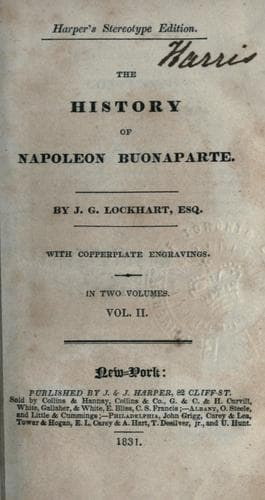
The History of Napoleon BuonaparteLockhart, J. G. (John Gibson)
History
The History of Napoleon Buonaparte
Lockhart, J. G. (John Gibson)
France -- Kings and rulers -- Biography; Napoleon I, Emperor of the French, 1769-1821
In order to check the hostile feeling excited among the sovereigns of
the continent by the murder of the Bourbon Prince, the French government
were now indefatigable in their efforts to connect the conspiracy of
Georges Cadoudal with the cabinet of England. The agents of the police
transformed themselves into numberless disguises, with the view of
drawing the British ministers resident at various courts of Germany into
some correspondence capable of being misrepresented, so as to suit the
purpose of their master. Mr. Drake, envoy at Munich, and Mr. Spencer
Smith, at Stuttgard, were deceived in this fashion; and some letters of
theirs, egregiously misinterpreted, furnished Buonaparte with a pretext
for complaining, to the sovereigns to whom they were accredited, that
they had stained the honour of the diplomatic body by leaguing
themselves with the schemes of the Chouan conspirators. The subservient
princes were forced to dismiss these gentlemen from their residences;
but the English ministry made such explanations in open Parliament as
effectually vindicated the name of their country. Lord Elgin, British
ambassador at Constantinople, had been one of those travellers detained
at the out-breaking of the war, and was now resident on his parole in
the south of France. He was, on some frivolous pretext, confined in a
solitary castle among the Pyrenees; and there every device was practised
to induce him to, at least, receive letters calculated, if discovered in
his possession, to compromise him. But this nobleman, sagaciously
penetrating the design, baffled it by his reserve. Being liberated from
confinement shortly after, he communicated what had happened to a
friend, a member of the French Senate, who traced the matter home to
some of Fouché's creatures, and congratulated Lord Elgin on having
avoided very narrowly the fate of Pichegru.
Sir George Rumbold, the British minister at Hamburg, escaped that
consummation still more narrowly. During the night of the 23rd October a
party of French soldiers passed the Elbe, as Ordonner and his gang had
crossed the Rhine on the 14th of March, and boldly seized Rumbold within
the territory of an independent and friendly state. He was hurried to
Paris, and confined in the fated dungeons of the Temple: but none of his
papers afforded any plausible pretext for resisting the powerful
remonstrance which the King of Prussia thought fit to make against an
outrage perpetrated almost within sight of his dominions; and, after a
few days, Sir George was set at liberty.
Public-domain text, read in full here on John Shaqi.
Reviews
Reviews
No reviews yet
Be the first to share your thoughts on this work.
Elsewhere in the archive
Join the Discussion
Join the discussion
Sign in to leave a comment or review.
Sign InorCreate an account