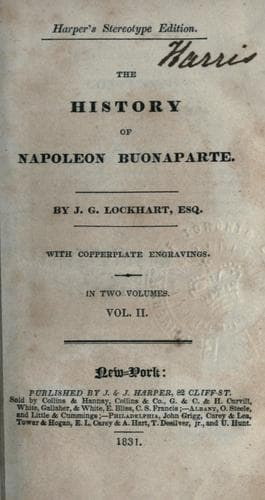
The History of Napoleon BuonaparteLockhart, J. G. (John Gibson)
History
The History of Napoleon Buonaparte
Lockhart, J. G. (John Gibson)
France -- Kings and rulers -- Biography; Napoleon I, Emperor of the French, 1769-1821
In view of the influence of the one book upon the other, and the one
writer upon the other, it is worth note that Lockhart had a fit of
enthusiasm over Scott's _Napoleon_ when it first appeared, or rather
when he first read the first six volumes of the work, before they were
"out," in 1827. He thought Scott would make as great an effect by it as
by any two of his novels. This proved a mistaken forecast, but Scott was
paid an enormous price--some eighteen thousand pounds. When then John
Murray, who had already co-opted Lockhart as his _Quarterly_ editor,
thought of inaugurating a "Family Library," and he proposed to his
editor this other Napoleon book, it must have seemed in many ways a very
attractive piece of work. But owing partly to Lockhart's relations with
Scott, and partly to the need of avoiding any literary comparisons,
these small, fat duodecimos appeared anonymously. That was, as it has
been already mentioned, in 1829, two years after Scott's book.
To-day, it makes a capital starting-point for the long Napoleon
adventure, whose end, so far as it is prolonged by fresh literary
divigations, seems to be as remote as ever.
It is from the French side that one might chiefly draw those vivid and
sometimes questionable glimpses at first-hand, that can best add to
Lockhart's presentment. One must compare his retreat from Russia with
Rapp's and other remembrancers' accounts, and be reminded by Rapp to go
on to Jomini's _Vie Militaire_, and even turn for a single personal
reminiscence to a flagrant hero-worshipper like Dumas, in his rapid and
military biography.
"Only twice in his life," said Dumas, "had he who writes these lines
seen Napoleon. The first time on the way to Ligny; the second, when he
returned from Waterloo. The first time in the light of a lamp; the first
time amid the acclamations of the multitude; the second, amid the
silence of a populace. Each time Napoleon was seated in the same
carriage, in the same seat, dressed in the same attire; each time, it
was the same look, lost and vague; each time, the same head, calm and
impassible, only his brow was a little more bent over his breast in
returning than in going. Was it from weariness that he could not sleep,
or from grief to have lost the world?"
This is the French postscript to many English books about the victor and
loser of the world.
* * * * *
The following is a list of the works of John Gibson Lockhart
(1794-1854):--
Peter's Letters to his Kinsfolk, by Peter Morris the Odontist (pseud.)
1819; Valerius, a Roman Story, 1821; Some Passages in the Life of Mr.
Adam Blair, 1822; Reginald Dalton, a Story of English University Life,
1823; Ancient Spanish Ballads (trans.) 1823; Matthew Wald, a Novel,
1824; Life of Robert Burns, 1828; History of Napoleon Buonaparte, 1829;
History of the late War, with Sketches of Nelson, Wellington and
Napoleon, 1832; Memoirs of the Life of Sir Walter Scott, 7 vols. 1836-8;
Theodore Hook, a Sketch, 1852.
Public-domain text, read in full here on John Shaqi.
Reviews
Reviews
No reviews yet
Be the first to share your thoughts on this work.
Join the Discussion
Join the discussion
Sign in to leave a comment or review.
Sign InorCreate an account