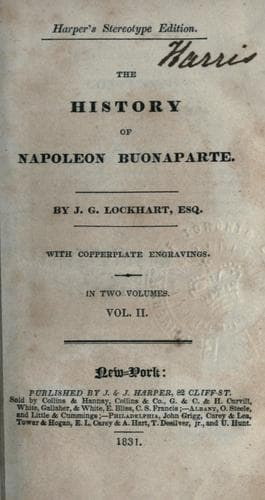
The History of Napoleon BuonaparteLockhart, J. G. (John Gibson)
History
The History of Napoleon Buonaparte
Lockhart, J. G. (John Gibson)
France -- Kings and rulers -- Biography; Napoleon I, Emperor of the French, 1769-1821
Lockhart was a Contributor to "Blackwood," and Editor of the "Quarterly
Review" from 1825 to 1853.
LIFE OF NAPOLEON BUONAPARTE
CHAPTER I
Birth and Parentage of Napoleon Buonaparte--His Education at
Brienne and at Paris--His Character at this Period--His Political
Predilections--He enters the Army as Second Lieutenant of
Artillery--His First Military Service in Corsica in 1793.
Napoleon Buonaparte was born at Ajaccio on the 15th of August, 1769. The
family had been of some distinction, during the middle ages, in Italy;
whence his branch of it removed to Corsica, in the troubled times of the
Guelphs and Gibellines. They were always considered as belonging to the
gentry of the island. Charles, the father of Napoleon, an advocate of
considerable reputation, married his mother, Letitia Ramolini, a young
woman eminent for beauty and for strength of mind, during the civil
war--when the Corsicans, under Paoli, were struggling to avoid the
domination of the French. The advocate had espoused the popular side in
that contest, and his lovely and high-spirited wife used to attend him
through the toils and dangers of his mountain campaigns. Upon the
termination of the war, he would have exiled himself along with Paoli;
but his relations dissuaded him from this step, and he was afterwards
reconciled to the conquering party, and protected and patronised by the
French governor of Corsica, the Count de Marbœuff.
It is said that Letitia had attended mass on the morning of the 15th of
August; and, being seized suddenly on her return, gave birth to the
future hero of his age, on a temporary couch covered with tapestry,
representing the heroes of the Iliad. He was her second child. Joseph,
afterwards King of Spain, was older than he: he had three younger
brothers, Lucien, Louis, and Jerome; and three sisters, Eliza, Caroline,
and Pauline. These grew up. Five others must have died in infancy; for
we are told that Letitia had given birth to thirteen children, when at
the age of thirty she became a widow.
In after-days, when Napoleon had climbed to sovereign power, many
flatterers were willing to give him a lofty pedigree. To the Emperor of
Austria, who would fain have traced his unwelcome son-in-law to some
petty princes of Treviso, he replied, "I am the Rodolph of my race,"[1]
and silenced, on a similar occasion, a professional genealogist, with,
"Friend, my patent dates from Monte Notte."[2]
Charles Buonaparte, by the French governor's kindness, received a legal
appointment in Corsica--that of _Procureur du Roi_ (answering nearly to
Attorney-General); and scandal has often said that Marbœuff was his
wife's lover. The story received no credence in Ajaccio.
Public-domain text, read in full here on John Shaqi.
Reviews
Reviews
No reviews yet
Be the first to share your thoughts on this work.
Join the Discussion
Join the discussion
Sign in to leave a comment or review.
Sign InorCreate an account