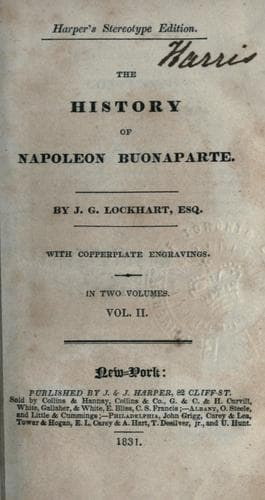
The History of Napoleon BuonaparteLockhart, J. G. (John Gibson)
History
The History of Napoleon Buonaparte
Lockhart, J. G. (John Gibson)
France -- Kings and rulers -- Biography; Napoleon I, Emperor of the French, 1769-1821
These words decided the fate of Napoleon and of France. Buonaparte had
been in the Odéon Theatre when the affair of Le Pelletier occurred, had
run out, and witnessed the result. He now happened to be in the gallery,
and heard the discussion concerning the conduct of Menou. He was
presently sent for, and asked his opinion as to that officer's retreat.
He explained what had happened, and how the evil might have been
avoided, in a manner which gave satisfaction. He was desired to assume
the command, and arrange his plan of defence as well as the
circumstances might permit; for it was already late at night, and the
decisive assault on the Tuileries was expected to take place next
morning. Buonaparte stated that the failure of the march of Menou had
been chiefly owing to the presence of the "Representatives of the
People," and refused to accept the command unless he received it free
from all such interference. They yielded: Barras was named
Commander-in-Chief; and Buonaparte second, with the virtual control. His
first care was to dispatch Murat, then a major of Chasseurs, to Sablons,
five miles off, where fifty great guns were posted. The Sectionaries
sent a stronger detachment for these cannon immediately afterwards; and
Murat, who passed them in the dark, would have gone in vain had he
received his orders but a few minutes later.
On the 4th of October (called in the revolutionary almanack the 13th
Vendemaire) the affray accordingly occurred. Thirty thousand National
Guards advanced, about two p.m., by different streets, to the siege of
the palace: but its defence was now in far other hands than those of
Louis XVI.
Buonaparte, having planted artillery on all the bridges, had effectually
secured the command of the river, and the safety of the Tuileries on one
side. He had placed cannon also at all the crossings of the streets by
which the National Guard could advance towards the other front; and
having posted his battalions in the garden of the Tuileries and Place du
Carousel, he awaited the attack.
The insurgents had no cannon; and they came along the narrow streets of
Paris in close and heavy columns. When one party reached the church of
St. Roche, in the Rue St. Honoré, they found a body of Buonaparte's
troops drawn up there, with two cannons. It is disputed on which side
the firing began; but in an instant the artillery swept the streets and
lanes, scattering grape-shot among the National Guards, and producing
such confusion that they were compelled to give way. The first shot was
a signal for all the batteries which Buonaparte had established; the
quays of the Seine, opposite to the Tuileries, were commanded by his
guns below the Palace and on the bridges. In less than an hour the
action was over. The insurgents fled in all directions, leaving the
streets covered with dead and wounded: the troops of the Convention
marched into the various sections, disarmed the terrified inhabitants,
and before nightfall everything was quiet.
Public-domain text, read in full here on John Shaqi.
Reviews
Reviews
No reviews yet
Be the first to share your thoughts on this work.
Join the Discussion
Join the discussion
Sign in to leave a comment or review.
Sign InorCreate an account