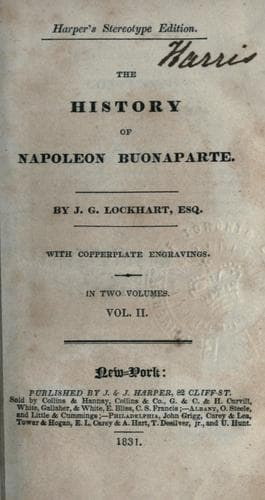
The History of Napoleon BuonaparteLockhart, J. G. (John Gibson)
History
The History of Napoleon Buonaparte
Lockhart, J. G. (John Gibson)
France -- Kings and rulers -- Biography; Napoleon I, Emperor of the French, 1769-1821
This eminent service secured the triumph of the Conventionalists, who
now, assuming new names, continued in effect to discharge their old
functions. Barras took his place at the head of _the Directory_, having
Sieyes, Carnot, and other less celebrated persons, for his colleagues;
and the First Director took care to reward the hand to which he owed his
elevation. Within five days from _the day of the Sections_ Buonaparte
was named second in command of the army of the interior; and shortly
afterwards, Barras, finding his duties as Director sufficient to occupy
his time, gave up the command-in-chief of the same army to his "little
Corsican officer."
He had no lack of duties to perform in this new character. The National
Guard was to be re-organised; a separate guard for the representative
body to be formed; the ordnance and military stores were all in a
dilapidated condition. The want of bread, too, was continually producing
popular riots, which could rarely be suppressed but by force of arms. On
one of these last occasions, a huge sturdy fishwife exhorted the mob to
keep to their places, when Buonaparte had almost persuaded them to
disperse. "These coxcombs with their epaulettes and gorgets," said she,
"care nothing for us; provided they feed well and fatten, we may
starve." "Good woman," cried the general of the interior, who at this
time was about the leanest of his race, "only look at me,--and decide
yourself which of the two is the fatter." The woman could not help
laughing: the joke pleased the multitude, and harmony was restored.
Buonaparte, holding the chief military command in the capital, and daily
rising in importance from the zeal and firmness of his conduct in this
high post, had now passed into the order of marked and distinguished
men. He continued, nevertheless, to lead in private a quiet and modest
life, studying as hard as ever, and but little seen in the circles of
gaiety. An accident which occurred one morning at his military levee,
gave at once a new turn to his mode of life, and a fresh impetus to the
advance of his fortunes.
A fine boy, of ten or twelve years of age, presented himself; stated to
the general that his name was Eugene Beauharnois, son of Viscount
Beauharnois, who had served as a general officer in the Republican
armies on the Rhine, and been murdered by Robespierre; and said his
errand was to recover the sword of his father. Buonaparte caused the
request to be complied with; and the tears of the boy, as he received
and kissed the relic, excited his interest. He treated Eugene so kindly,
that next day his mother, Josephine de Beauharnois, came to thank him;
and her beauty and singular gracefulness of address made a strong
impression.
Public-domain text, read in full here on John Shaqi.
Reviews
Reviews
No reviews yet
Be the first to share your thoughts on this work.
Join the Discussion
Join the discussion
Sign in to leave a comment or review.
Sign InorCreate an account