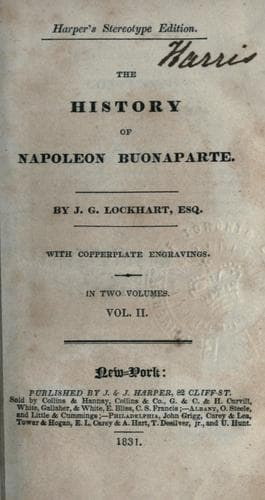
The History of Napoleon BuonaparteLockhart, J. G. (John Gibson)
History
The History of Napoleon Buonaparte
Lockhart, J. G. (John Gibson)
France -- Kings and rulers -- Biography; Napoleon I, Emperor of the French, 1769-1821
This charming lady, the daughter of a planter, by name Tascher de la
Pagerie, was born in the island of Martinico, 24th June, 1763. While yet
an infant, according to a story which she afterwards repeated, a negro
sorceress had prophesied that "she should one day be greater than a
queen, and yet outlive her dignity."[7]
The widow of Beauharnois had been herself imprisoned until the downfall
of Robespierre. In that confinement she had formed a strict friendship
with another lady who was now married to Tallien, one of the most
eminent of the leaders of the Convention. Madame Tallien had introduced
Josephine to her husband's friends; and Barras, the First Director,
having now begun to hold a sort of court at the Luxembourg, these two
beautiful women were the chief ornaments of its society. It was
commonly said--indeed it was universally believed--that Josephine, whose
character was in some respects indifferent, possessed more than
legitimate influence over the First Director. Buonaparte, however,
offered her his hand; she, after some hesitation, accepted it; and the
young general by this marriage (9th March, 1796) cemented his connection
with the society of the Luxembourg, and in particular with Barras and
Tallien, at that moment the most powerful men in France.
Napoleon had a strong tendency to the superstition of fatalism, and he
always believed that his fortunes were bound up in some mysterious
manner with those of this graceful woman. She loved him warmly, and
served him well. Her influence over him was great, and it was always
exerted on the side of humanity. She, and she alone, could overrule, by
gentleness, the excesses of passion to which he was liable; and her
subsequent fate will always form one of the darkest pages in the history
of her lord.
Tranquillity was now restored in Paris; and the Directory had leisure to
turn their attention to the affairs of the army of Italy, which were in
a most confused and unsatisfactory condition. They determined to give it
a new general; and Buonaparte was appointed to the splendid command. It
is acknowledged, in one of Josephine's letters, that the First Director
had promised to procure it for him before their marriage took place.
"Advance this man," said Barras to his colleagues, "or he will advance
himself without you."
Buonaparte quitted his wife ten days after their marriage; paid a short
visit to his mother at Marseilles; and arrived, after a rapid journey,
at the headquarters at Nice. From that moment opened the most brilliant
scene of his existence; yet, during the months of victory and glory that
composed it, his letters, full of love and home-sickness, attest the
reluctance with which he had so soon abandoned his bride.
[Footnote 6: De Bourienne.]
[Footnote 7: According to some, the last clause ran "die in an
hospital," and this was in the sequel interpreted to mean Malmaison--a
palace which (like our own St. James's) had once been an hospital.]
CHAPTER IV
Public-domain text, read in full here on John Shaqi.
Reviews
Reviews
No reviews yet
Be the first to share your thoughts on this work.
Join the Discussion
Join the discussion
Sign in to leave a comment or review.
Sign InorCreate an account