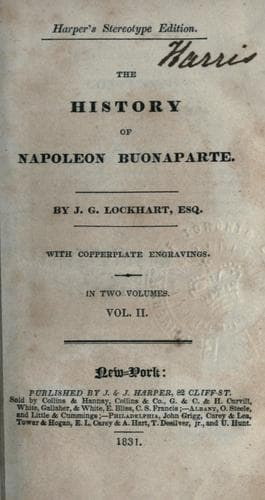
The History of Napoleon BuonaparteLockhart, J. G. (John Gibson)
History
The History of Napoleon Buonaparte
Lockhart, J. G. (John Gibson)
France -- Kings and rulers -- Biography; Napoleon I, Emperor of the French, 1769-1821
convention, and detained them as prisoners--thus, foolishly as well a
wickedly, imitating the perfidy of Napoleon's own conduct to Spain. This
battle and capitulation of Baylen were termed by the Emperor himself
_the Caudine forks_ of the French army. He attributed the disaster to
treachery on the part of Dupont: it was the result of the rashness of
the expedition, and the incompetency of the conductor. The richest part
of Spain was freed wholly of the invaders: the light troops of Castaños
pushed on, and swept the country before them; and within ten days, King
Joseph perceived the necessity of quitting Madrid, and removed his
headquarters to Vittoria.
In the meantime Lefebre Desnouettes, whose early success in Arragon has
been alluded to, was occupied with the siege of Zaragossa--the
inhabitants of which city had risen in the first outbreak, and prepared
to defend their walls to the last extremity. Don Jose Palafox, a young
nobleman of no great talents, who had made his escape from Bayonne, was
invested with the command; but the real leaders were the priests and
some of the private citizens, who selected him for the prominent place
as belonging to a family of eminent distinction in their kingdom, but in
effect considered and used him as their tool. Some Spanish and Walloon
regiments, who had formed the garrisons of strong places treacherously
seized by the enemy before the war commenced, had united with Palafox,
and various bloody skirmishes had occurred--ere the French general was
enabled to shut them up in Zaragossa and form the siege. The importance
of success in this enterprise was momentous, especially after the
failure of Moncey at Valencia. Napoleon himself early saw, that if the
Valencians should be able to form an union with the Arragonese at
Zaragossa, the situation of the Catalonian insurgents on the one side
would be prodigiously strengthened; while, on the other hand, the armies
of Leon and Galicia (whose coasts offered the means of continual
communication with England) would conduct their operations in the
immediate vicinity of the only great road left open between Madrid and
Bayonne--the route by Burgos. He therefore had instructed Savary to
consider Zaragossa as an object of the very highest importance; but the
corps of Lefebre was not strengthened as the Emperor would have wished
it to be, ere he sat down before Zaragossa. The siege was pressed with
the utmost vigour; but the immortal heroism of the citizens baffled all
the valour of the French. There were no regular works worthy of notice:
but the old Moorish walls, not above eight or ten feet in height, and
some extensive monastic buildings in the outskirts of the city, being
manned by crowds of determined men, whose wives and daughters looked on,
nay, mingled boldly in their defence--the besiegers were held at bay
week after week, and saw their ranks thinned in continual assaults
without being able to secure any adequate advantage. Famine came and
Public-domain text, read in full here on John Shaqi.
Reviews
Reviews
No reviews yet
Be the first to share your thoughts on this work.
Elsewhere in the archive
Join the Discussion
Join the discussion
Sign in to leave a comment or review.
Sign InorCreate an account